Category Archives: Things that are Real

Solving for Pattern or, an Economy of Size

I have been reading lately.  I have been reading a lot, lately….  I could not sleep last night.  An old article by Wendell Berry gave me thoughts to consider and apply to my own small business.


Solving for Pattern.  Written by Wendell Berry.  Chapter 9 in The Gift of the Land:  Further Essays Cultural & Agricultural.  North Point Press, 1981.  Originally published in the Rodale Press periodical The New Farm.

Wendell Berry is a farmer and an author.  His writing is thought provoking and disturbing, well written, easy to read and difficult to walk away from…


Wendell Berry has been on my reading list for a long time.  It is time for us to get to know him, now!  Solving for Pattern is a short article that poses questions and discusses the long term meaning of economy.  Not of economics.  Economy.  Economy of size.  Small businesses.  Small farms.

Questions…  I went back to university several years ago.  I thought I just wanted to take a few courses, make my evenings a little more interesting.  I discovered that I was learning to read in a way that I had not even considered possible.  I am still learning about reading but now, I am also reading to learn to ask questions.  Wendell Berry has been asking these questions for a long time.  His questions about patterns, economy, conservation, and healthy living are worth considering.


Further Readings (I have already started reading The Unsettling of America):

Wendell Berry, The Unsettling of America:  Culture & Agriculture.  1977.  Sierra Club Books, San Francisco, 1977.  This book is available in most libraries.  Read a review of this book here.

James George Frazer, The Golden Bough.  First published in 1890.  My edition was published in 1994 by Oxford University Press.  Available online, free, here.


National Gallery Postcard, circa 1950’s – van de Velde, Coast Scene: Calm

This is a vintage postcard out of my collection.  I like pieces of paper.  They are tangible things that people place a great deal of trust in.  Maps, charts, postcards, money, stamps….  They are all worth something, they just aren’t always worth a lot.

Please note that several of the links I have placed in this post are slightly ‘off topic.’  That is, there is a link showing for Trafalgar Square but, it is a link to “interglacial deposits” that were found there during the 1950s.  There is so much to this world that is just beneath the surface (or, the pavement….).


This postcard was printed for the National Gallery in London – and most likely purchased as a gallery souvenir.

National Gallery, Card No. 1115. Van de Velde: Coast Scene: Calm (871).  Printed in Great Britain for the Trustees under the authority of Her Majesty's Stationery Office by Waterlow & Sons Limited, London.  Wt: P1838

National Gallery, Card No. 1115. Van de Velde: Coast Scene: Calm (871). Printed in Great Britain for the Trustees under the authority of Her Majesty’s Stationery Office by Waterlow & Sons Limited, London. Wt: P1838

The National Gallery, located in Trafalgar Square, London, was established in 1824 and has been open to the public – free of charge – for most of the years between then and now…

The painting on this postcard is “Dutch Vessels Inshore and Men Bathing” by Willem van de Velde, 1661.  It is a painting of Men-of-War and men.


There are links to peer-reviewed articles in this post.  There is a lot of knowledge in these papers.  One of my many habits is to go through the reference lists, end notes and bibliographies to look for more information that I might enjoy reading.  This is a link to a small portion of the research that the authors of the articles have included.

Reading List for April 16, 2015 post

Why?  Because everything is connected…


Beautiful Warnings….

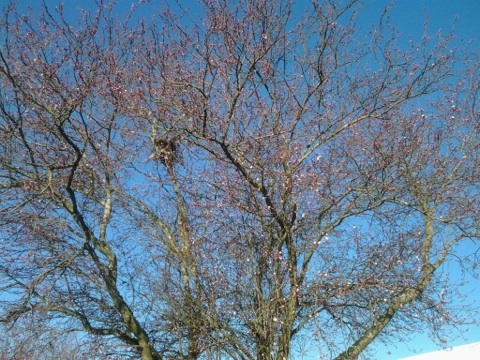
The cherry trees lining the street where I work now are in bloom.  I have the privilege of walking by them several days a week.  Many of the buds have opened.

The "For Rent" sign was removed from this nest on Monday afternoon.  Renovations are underway and the new tenants are noisy and cheeky....

The “For Rent” sign was removed from this nest on Monday afternoon. Renovations are underway and the new tenants are noisy and cheeky….


This afternoon, there are more blossoms open.  Tomorrow the show of pink against blue should be stunning.

Tuesday Blossoms and the sky is even bluer....

Tuesday Blossoms and the sky is even bluer….


I have been privileged to stand watch as a four hour sunset turned into a four hour sunrise.  That was many July’s ago during a 12 hour graveyard shift on the roof of a coker at Syncrude.

I do not have a photograph, only memories…  Inside the plant, personal cameras are not allowed to be carried by employees.


Today is February 23, 2014.

The photos of the cherry blossoms were taken in Richmond, British Columbia, Canada where in February’s past we have huddled under umbrellas, pulling our jackets close as the cold winds blew in off of the water.  I grew up here.  The cold winds and wet weather of winter are what is necessary to keep the rain forests green.


Climate change is real.


I have recently read Naomi Klein’s newest book, This Changes Everything:  Capitalism vs. The Climate.  I do not believe that she exaggerates any point.


Every small thing we do (or don’t do) to stop the change helps.

Do Animals ‘Drink’ Intentionally?

A link to the following article was in my mail yesterday.  The article is interesting however, I don’t think it really gets at what might be underlying causes of birds imbibing a little too much or a little too frequently….

James MacDonald.  2014.  When Birds Drink Too Much.  JSTOR Daily, January 1,4 2015.


There are two articles cited by the above mini-article.  I think that they are important and can be read online without any extra cost.

Frank Wiens, Annette Zitzmann, Marc-Andre Lachance, Michel Yegles, Fritz Pragst, Friedrich M. Wurst, Dietrich von Holst, Saw Leng Guan, and Rainer Spanagel.  2008.  Chronic intake of fermented floral nectar by wild treeshrews.  PNAS, Volume 105, No. 30, pages 10426-10431.

S.D. Fitzgerald, J.M. Sullivan and R.J. Everson.  1990.  Suspected Ethanol Toxicosis in Two Wild Cedar Waxwings.  Avian Diseases, Volume 34, No. 2, (Apr. – Jun., 1990), pages 488-490.


~~~

Treeshrews?  Waxwings?

Eberhard Fuchs and Silke Cobach-Sohle.  2010.  Tree shrews in The UFAW handbook on the care and management of laboratory and other research animals, 8th ed. Oxford, UK:  Wiley-Blackwell, pages 262-275.

Loren S. Putnam.  1949.  The Life History of the Cedar Waxwing.  The Wilson Bulletin, pages 141-182.


~~~

My thoughts on this are going towards the caloric intake in fruits and berries that are fermented or are in the process of fermenting.  It seems to me that it might be higher than when the fruits and berries have just freshly ripened.

Eva M. Sehub,Alan C. Logan, and Alison C. Bested.  2014.  Fermented foods, microbiota, and mental health:  ancient practice meets nutritional psychiatry.  Journal of Physiological Anthropology.  Article 332.


~~~

Is it just the birds or do other creatures like a little drink now and then too?

Cheryl D. Knott.  1998.  Changes in Orangutan Caloric Intake, Energy Balance, and Ketones in Response to Fluctuating Fruit Availability.  International Journal of Primatology.  Volume 19, No. 6, pages 1061


~~~

Reading a bit further and another thought occurred to me!  Higher caloric intake for wildlife, just before winter sets in, would be useful for survival.  Putting on a little weight to get through the cold dark nights.  Can the fermentation of fruits provide other contributions to survival?

James O. Vafidis, Ian P. Vaughan, T. Hefin Jones, Richard J. Facey, Rob Parry, Robert J. Thomas.  2014.  Habitat Use and Body Mass Regulation among Warblers in the Sahel Region during the Non-Breeding Season.  PLOS One.  doi:10.1371/journal.pone.0113665

Mark C. Witmer.  1996.  Annual Diet of Cedar Waxwings Based on U.S. Biological Survey Records (1885-1950) Compared to Diet of American Robins:  Contrasts in Dietary Patterns and Natural History.  The Auk.  Volume 113, No. 2, Pages 414-430.


~~~

So, if the intoxicating fruits and berries are a good thing, why are some birds overdoing it?  Now?  Could it be that there is less competition for these yummy morsels?  Fewer birds equals more party favours?

Jennifer A. Howard.  2014.  The Lesser Coverts of Game Birds.  Booth, Volume 6, No. 2, Page 1-2.

Probably not the best answer to my question but, a very good short story!  One that has me thinking a bit further off-track than usual.  I will come back to this story for another post.


~~~

And then, there are people….

Laren Cordain, S. Boyd Eaton, Anthony Sebastian, Neil Mann, Staffan Lindeberg, Bruce A Watkins, James H. O’Keefe, and Janette Brand-Miller.  2005.  Origins and evolution of the Western diet:  health implications for the 21st century.  The American Journal of Clinical Nutrition.  Volume 81, pages 341-354.

Manas Ranjan Swain, Marimuthu Anandharaj, Ramesh Chandra Ray, and Rizwana parveen Rani.  2014.  Fermented Fruits and Vegetables of Asia:  A Potential Source of Probiotics.  Hindawi Publishing Corporation Biotechnology Research International.  http://dx.doi.org/10.1155/2014/250424


~~~

And, because we can think of other things to do with ethanol products…

Veeranjaneya Reddy Lebaka, Hwa-Won Ryu, and Young-Jung Wee.  2014.  Effect of fruit pulp supplementation on rapid and enhanced ethanol production in very high gravity (VHG) fermentation.  SpringerLink.  doi:  10.1186/s40643-014-0022-8


~~~

And thinking along these lines… maybe we need to look at chronic diseases that may have some beginning in the foods that are available to us now as well as those that we choose to eat a lot of and, without competition, possibly eat a little too regularly – much like the small woodland creatures and birds in the first few articles.

Your thoughts are important to me and to continuing this as a discussion.  Please comment….


Dear Mr. Deity,

Thank you for sending us your newest YouTube video.  You have taken great care to explain why it is wrong to punch someone in the nose for not liking someone’s mom and I appreciate this!


A link to Mr. Deity

The Way of the Mister  —  These words are offensive!  This video is offensive!  It is a must watch!  I am not offended by this video, I am offended by the fact that the Catholic Church will probably get away with yet another offensive speech by yet another offensive leader, without understanding what it is they have done, are doing, and will likely continue to do.

I have a hard copy of the transcript (available beneath the YouTube video), just in case it disappears!

A link to the article in The Guardian where the Pope is quoted.


There is no excuse.


~~~~~

Now, a few bits from articles on a few of the points made by Mr. Deity (aka Brian Keith Dalton).  It is important because it is all connected!

Please note that I have not read any of these articles (yet).  I have taken a quick peek and I have saved and/or printed them for later perusal and bibliography mining!


~~~~~

Satire:

Botha, E.  2014.  A means to an end:  Using political satire to go viral.  Public Relations Review, Volume 40, Number 1.  http://dx.doi.org/10.1016/j.pubrev.2013.11.023

Joan Ozark Holmer.  1981.  Religious Satire in Herrick’s “The Fairie Temple: or, Oberons Chappell.“  Renaissance and Reformation: Renaissance et Réforme, Volume 17, No. 1, pages 40-56.

Drew Kaup.  2014.  Unaffiliation:  Where the New Atheists Went Wrong, and How South Park Paved the Way for the ‘Rise of the Nones’.  Thesis submitted to the Faculty of Emory College of Arts and Sciences of Emory University, Department of Religion.

Heather L. LaMarre, Kristen D. Landreville and Michael A. Beam.  2009.  The Irony of Satire:  Political Ideology and the Motivation to See What You Want to See in The Colbert Report.  International Journal of Press/Politics, Volume 14, Number 2, April 2009, pages 212-231.

Richard Strier.  2011.  The Unrepentant Renaissance:  from Petrarch to Shakespeare to Milton.  University of Chicago Press.  (Available in libraries, bookstores and online.)

George W. Whiting.  1930.  Political Satire in London Stage Plays, 1680-83.  Modern Philology, Volume 28, No. 1 (August, 1930), pages 29-43.


Moral Credibility:

Dan M. Kahan.  1997.  Between Economics and Sociology:  The New Path of Deterrence.  Michigan Law Review, Volume 95, No. 8 (August 1997), pages 2477-2497.

Paul H. Robinson.  1994.  Moral Credibility and Crime.  The Atlantic Monthly. 8/18/1994.  Draft only.

Paul H. Robinson and Sarah Robinson.  2014.  Punishment:  Drop City and the Utopian Communes, Chapter 3 in Living Beyond the Law:  Lessons from Pirates, Prisoners, Lepers, and Survivors.  Lanham, Boulder, New York, Toronto, and Plymouth, UK:  Rowman & Littlefield.  Pages 49-62.


The Catholic Pope and Violence:

Patrick McKinley Brennan.  2013.  Subsidiarity in the Tradition of Catholic Social Doctrine, Chapter in Subsidiarity in Comparative Perspective.  Michelle Evans and Augusto Zimmermann (eds.).  Springer.  Villanova University School of Law, School of Law Working Paper Series, 2012, Paper 173.

Jeffrey S. Burwell.  2014.  Pope Francis and Bill 18:  How his vision of non-judgment could temper the ways that administrators of Catholic schools in Manitoba integrate the Safe and Inclusive Schools amendment.  University of Manitoba, St. Paul’s College.

Christian Fiala and Joyce H. Arthur.  2014.  “Dishonourable disobedience” – Why refusal to treat in reproductive healthcare is not conscientious objection.  Women – Psychosomatic Gynaecology and Obstetrics, Volume 1, December 2014, pages 12-23.

Warwick Middleton, Pam Stavropoulos, Martin J. Dorahy, Christa Kruger, Roberto Lewis-Fernandez, Alfonso Martinez-Taboas, Vedat Sar and Bethany Brand.  2014.  The Australian Royal Commission into Institutional Responses to Child Sexual Abuse.  Australian and New Zealand Journal of Psychiatry, Volume 48, Number 17, pages 17-21.  DOI: 10.1177/0004867413514639

Kurt Nelson.  2014.  Review of Faith, Resistance, and the Future:  Daniel Berrigan’s Challenge to Catholic Social Thought.  James L. Marsh and Anna J. Brown (Eds.).  New York:  Fordham University Press, 2012.  (Available in libraries, bookstores and online.) Journal of Catholic Education, Volume 17, Issue 2, Article 11, pages 175-178.

Gareth C. Payne, Rebecca E. Payne, and Daniel M. Farewell.  2008.  Rugby (the religion of Wales) and its influence on the Catholic Church.  Should Pope Benedict XVI be worried?  BMJ.com  doi:10.1136/bmj.a2768


Freedom of Speech:

Zechariah Chafee, J.  1919.  Freedom of Speech in War Time.  Harvard Law Review, Volume 32, No. 8 (Jun., 1919), pages 932-973.

Erwin Chemerinsky.  2000.  Content Neutrality as a Central Problem of Freedom of Speech:  Problems in the Supreme Court’s Application.  S. Cal. L. Rev. 74:  49.

Charles C. Helwig.  1995.  Adolescents’ and Young Adults’ Conceptions of Civil Liberties:  Freedom of Speech and Religion.  Child Development, Volume 66, Number 1,  Pages 152-166.

Lasa Sun.  2014.  The role of diversity on freedom of speech in democratic societies.  International Journal of Sustainable Human Development, Volume 2, Number 2, pages 44-51.

Gary Watt.  2014.  Judicial Allusion as Ornament:  A Response to John Curtis’s, ‘Twitter, King Lear, and the Freedom of Speech.’  Exchanges: the Warwick Research Journal, Volume 1, No. 2.  University of Warwick.


~~~

I have given myself a big list to prepare for you!  A combined bibliography with links will be available soon.  If I take too long, please send a  note.  It helps to know there are people waiting for these.


~~~

Now, go read!  Then make up your own mind and leave a comment…

Also, please add links to more articles and books in the comments.  There is so much more!


Je Suis Charlie

My thoughts are with the victims.  Not just of this atrocity but of all atrocities.


~~~

http://www.charliehebdo.fr


~~~

http://www.cbc.ca/news/world/charlie-hebdo-cover-to-feature-prophet-muhammad-with-tear-on-cheek-1.2898787

http://www.telegraph.co.uk/news/worldnews/europe/france/11340358/Charlie-Hebdos-Wednesday-edition-to-include-Prophet-Mohammed-cartoons.html


~~~

Words such as condone and condemn have very different meanings.  I have heard that the actions of a few are not ‘condoned.’  I have yet to hear that the actions of the past weeks have been ‘condemned’ by any group.  Words are being carefully chosen, text is being carefully sanitized, articles have been carefully ameliorated to protect feelings rather than to preserve human rights.  We publish names of the innocent and names of the accused but we cannot convey the full meaning of an event, a tragedy, an atrocity if the language used has been softened to protect feelings….

To not report news, in full, because it might offend “somebody” is to fall far short of being fair, honest and open to all and this includes those who may be offended.  (There is a long tradition of not putting true images of prophets, gods and others….  on paper.  A 2,500 year old [a guess at the number of years that have passed since Buddha discouraged the manufacture of his likeness] discouragement of representations of Buddha is an example.)  When did the lawyers decide that news must not be offensive?  News, to be considered news, is a reporting of offenses and the results of offenses!  To do otherwise is truly offensive.


“‘To be explicit, easy, free, and very plain’ was the ideal set down for himself by Daniel Defoe…  No wonder he was one of the most popular journalists of his own time [18th century].” Murray Sheehan, Hints of News Reporting (Little Blue Book No. 342), 1922.  Daniel Defoe wrote Moll Flanders and Robinson Crusoe as well as many other books in addition to being a 17th/18th century journalist.


Deuze, Mark.  2005.  What is Journalism?  Professional Identity and Ideology of Journalists Reconsidered.  SAGE Publications.  http://site.iugaza.edu.ps/mamer/files/What-is-Journalism1.pdf


~~~

My French and Spanish are extremely poor.  I do not know any Arabic, however, this will not stop me from purchasing a copy of the next edition of Charlie Hebdo (which will be published in French, Spanish, Arabic and English) whether or not I find a copy in English.  My purchase will be in support of those who have died, in support of those who continue to work at this newspaper, and in support of a future with greater freedom and greater protection of human rights for everyone.  I plan on this being only my first copy of Charlie Hebdo.  We need to continue to support these very brave people after the headlines disappear into history!


~~~

Access to education is our single best bet!

Pritchett, Lant.  2004.  Access to Education.  Chapter 4 in Global Crises, Global Solutions.  Edited by Bjorn Lomborg. Cambridge:  Cambridge University Press.  http://books.google.ca/books?hl=en&lr=&id=KQ2_zplu8mUC&oi=fnd&pg=PA175&ots=Ti0qUOHBh7&sig=z_uNHU9enIXwR7KyUqDenIu88fQ#v=onepage&q&f=false


~~~

Please add links to articles, blog posts, anything…  that supports the victims of these atrocities and the human right to safety for all.


Small Change… Re-inventing Small Business on a Global Scale

I have an Etsy shop!  It has become a goal to be able to work without schedule, to be able to study, create, get enough sleep, and pay my bills without have to time my morning coffee to the public transit schedule….

With this in mind, I began to go through some articles that I have here.  Some are printed out, some are online, some have a partially finished precis.  They are all interesting and in putting this post together I have read parts of all them although, not all of them have made it here.

~~~~~

Article:  Embroidery as Participation?  Women in the Calakmul Model Forest, Campeche, Mexico.  pdf

Author:  Julia E. Murphy.  Professor of Anthropology at Kwantlen Polytechnic University

Published in:  2003

Journal:  Canadian Woman Studies, les cahiers de la femme, Vol. 23, No. 1, pages 159-167.

My copy was downloaded in November, 2014.  I found it here http://pi.library.yorku.ca/ojs/index.php/cws/article/view/6376

Why this article interested me:  I love embroidery!  I learned to do embroidery from my grandmother.  When my daughter was small, my ability to knit helped to pay the bills.  Small ventures in a cooperative atmosphere can make life easier.


~~~~~

Article:  Village Development Groups:  Model Based on Participation in Achieving Rural Development.  pdf

Authors:  Mahmoud Falsolaiman, Hojat Sadeghi, and Mohammad Hajipur.

Published in:  2014

Journal:  Journal of Geography and Regional Planning, Vol. 7, No. 4, June 2014, pages 78-85.

My copy was downloaded in November, 2014.  I found it here http://www.academicjournals.org/article/article1403017553_Mahmoud%20et%20al.pdf

Why this article interested me:  After finding the article by Julia Murphy, I went looking for more.  One of the keyword groups I used was “micro credit.”  Developing small businesses with very small amounts of venture capital has worked and is working.  I wanted to know more!


~~~~~

Article:  New Venture Teams:  A Review of the Literature and Roadmap for Future Research.  pdf

Authors:  Anthony C. Klotz, Keith M. Hmieleski, Bret H. Bradley, and Lowell W. Busenitz.

Publisher:  Journal of Management, Vol. 40, No. 1.

DOI:  10.1177/0149206313493325

Publication Date:  January 2014.

My copy was downloaded in November, 2014.  I found it here http://jom.sagepub.com/content/40/1/226.full.pdf+html

Find more of Anthony Klotz’s writing here  –  Publications List

Find more of Keith Hmieleski’s writing here  –  Publications List

Find more of Bret Bradley’s writing here  –  Publications List

Find more of Lowell Busenitz’s writing here  –  Publications List

Why this article interested me:  So, starting a business…  Venture capital…  Taking a chance…  Is there still a climate in North America for the small partnership to succeed?  I found this article.  It has a lot about studies, research, benefits.  But, cooperation between individuals was my question.


~~~~~

Article:  Does Studying Economics Inhibit Cooperation?.  pdf

Authors:  Robert H. Frank, Thomas Gilovich and Dennis T. Regan.

Publisher:  American Economic Association, Vol. 7, No. 2, pages 159-171.

Publication Date:  Spring, 1993.

My copy was downloaded in November, 2014.  I found it here

Click to access 00242.pdf

Find more of Robert Frank’s writing here  –  Publications List

Find more of Thomas Gilovich’s writing here  –  Publications List

Find more of Dennis Regan’s writing here  –  Publications List

Why this article?  Because the title caught my attention!  To find out more about the differences between economics majors and non-economics majors and how self-interest might play a role in business decisions, this is a lighter than average and, an interesting read!


~~~~~

Book:  A Handbook of Fist Puppets.  By Bessie Alexander Ficklen:  With eight reproductions from photographs and numerous line drawings by Julie Brown

Published in:  1935.

Publisher:  Frederick A. Stocks Company.  New York.

Library Holdings:  One copy (1963) is available in the reference section at the Toronto Public Library.  Link

There are also many copies of this book for sale, online…

Why this book?  The title of Chapter XIV is “Money-Making with Fist Puppets.”  This book was a $1 find at a library book sale many years ago.  I have enjoyed browsing the pages and it holds a special place on my bookshelf.  Even though I will probably never venture to sell handmade fist puppets or write or stage my own fist puppet play, the author of this book encourages this as a means of creativity and possible income.  There is also a short, annotated, bibliography!


~~~~~

Article:  Willow Smoke and Dogs’ Tails:  Hunter-Gatherer Settlement Systems and Archaeological Site Formation.  pdf

Author:  Lewis R. Binford

Publisher:  American Antiquity, Vol. 45, No. 1, pages 4-20.

Publication Date:  January 1980.

My copy was downloaded in 2014.  I found it here

Click to access Binford%2080%20American%20Antiquity%20Willow%20smoke.pdf

Find more of Lewis Binford’s writing here  –  Publications List

Why this paper?  Lewis Binford’s description of the Nunamiut, “logistically organized.”  Hunter-gatherer’s used their knowledge of the world around them to survive.  They had to know when to move, when to stay, who to trade with.  I love reading about ancient civilizations.  We have discovered a lot about many civilizations, peoples, cultures but, we can only guess at what they knew and how they knew it.

Biology is about survival and there are only two outcomes to business, success and failure.  Life is about much more.  It is about cooperation, successes and failures, personal growth and continuation despite the outcomes.  We need to read!


~~~~~

If any of these links do not work, please contact me and I will try to help you find the article or book that you are looking for.

~~~~~

If you find any broken links on this blog, please leave a comment or send me a note so that it can be repaired.  Thank  you….

Links to Two Articles on Molecular Cell Biology – Yes, I do read this stuff….

I am placing the link information for these articles here with the thought that easier access to articles such as this will encourage reading (or, maybe in this case curiosity) and open discussion.  This is also an open invitation for you to write a precis on this article (or, any other article that you find necessary or interesting)….

Once you actually get into reading articles like these ones, they are not nearly as intimidating as they could be!  This particular article even gives you some of the trickier definitions in the marginalia.

You can find more Biochemistry articles here.

~~~~~

Article:  Versatility of the Mitochondrial Protein Import Machinery.

Authors:  Nikolaus Pfanner (Publications List) and Andreas Geissler.

Published in:  2001

Journal:  Nature Reviews, Molecular Cell Biology, Volume 2, May 2001, pages 339 – 349.

My copy was downloaded in November, 2014.  I found it here

Click to access Geissler%20and%20Pfanner.pdf

If any of the links do not work, please send a note or leave a comment and I will try to help.

~~~~~

~~~~~

Article:  The Versatility and Universality of Calcium Signalling.

Authors:  Michael J. Berridge (Publications), Peter Lipp and Martin D. Bootman

Published in:  2000

Journal:  Nature Reviews, Molecular Cell Biology.  Volume 1, October 2000, pages 11 – 21.

My copy was downloaded in November, 2014.  I found it here http://web1.johnshopkins.edu/csl/academics/580427/rsc/580427_4_calciumsignalingreview_032106.pdf

Publications Lists for the Authors:

  • Michael J. Berridge  –  Link
  • Peter Lipp  –  Link
  • Martin D. Bootman  –  Link

If any of the links do not work, please send a note or leave a comment and I will try to help.

~~~~~

If you find any broken links on this blog, please leave a comment or send me a note so that it can be repaired.  Thank  you….

Annotated List (with Links) of University Lab, Publications Lists – This is a Work in Progress…

This is a Work in Progress…

Searching is easy, until we can’t find something that we need….  This list might help.  It takes us to places that Google generally cannot get into unless you know very specific key words to use.  This is usually the entire title of the article!  In fact, if there is something on one of these list that you have trouble finding, try copying and pasting the ‘entire’ title into this search box.  If that doesn’t work, send me a note and I will try to help….

This will be a very long list and it will be added to whenever I find new and interesting lists to add to it!  If you know of a publication list that you would like to see added here, please let me know  —  this type of list can be really hard to find….

~~~~~

Anthropology

Kwantlen Polytechnic University 

The Anthropology Faculty  –  Most of the instructors and professors in this department and are published.  Most have also provided at least a partial list of their writing and there is some very interesting writing here!

Anthropology Department Resource List  –  There are some amazing links here.  If you are looking for information on pretty much anything anthropology related, spend a few free clicks through this page.

~~~~~

Biology

Michigan State University

Richard E. Lenski  –  The Experimental Evolution page is a very long list of some incredibly amazing work!  Track the progress of the 50,000 Generation Project by going back through time (and articles) to get real details and real information!

~~~~~

Chemistry

Kwantlen Polytechnic University  –  There is a good list of web sites, databases and other university chemistry departments here.    I will be checking some of these links out soon.

~~~~~

Classical Studies

University of Winnipeg

Classic Studies Faculty  –  Full and partial publication lists of faculty members.  I just found these lists and have not gone through them too thoroughly yet.

~~~~~

Criminology

Kwantlen Polytechnic University  –  There is only one faculty showing off their writing skills here.  Greg Jenion.   However, the Resources page here is fairly well stocked with good links!

University of Winnipeg  –  Criminal Justice Department Resource List.  I have checked out a few of these links and, if you are willing to put in a few clicks, you may find some publications lists that are absolutely amazing!

~~~~~

Ecology

University of British Columbia  –  The Hinch Lab is an incredible source of information on Wild Salmon!   The articles listed here are from 1986 to present and every article I have looked at is well written with an excellent reference list!

University of Winnipeg  – 

The Publications List at the Lingle Lab is a good source for interesting local information.

~~~~~

Environmental Protection

Kwantlen Polytechnic University  –  A good starting place for information on protecting the environment and staying safe doing it!

~~~~~

Gender Studies

University of Winnipeg  –  Most of the professors and instructors listed here have a biography which includes some very interesting publications lists.

~~~~~

Geography

Kwantlen Polytechnic University  –  The Geography Department has a fair resources page.    Several of the links will take you to resources pages of larger universities.  I will be checking them out!

~~~~~

History

University of Winnipeg  –  There are a couple of professors teaching Mennonite history here.  There are publications lists.

–  German-Canadian Studies.  This department has compiled an excellent list of articles and books.

~~~~~

Mathematics

Kwantlen Polytechnic University  –  There are some sources here that you will find very helpful whether you are studying for exams or just trying to figure out the math that the local newspaper is using to convince you of something (well, maybe not…)

~~~~~

Political Science

University of Winnipeg  –  The faculty list has a bio for every professor and many of the bios do include publication lists.

~~~~~

Urban and Inner-City Studies

University of Winnipeg  –  This goes to the  faculty page for Urban and Inner-City Studies.  There are some well published professors here.

~~~~~

Working Title: Predictions in regards to the Canadian Industrial Labour Force based on Census Data

As you scroll down you might notice that the precis is missing….  This is because, well, because it is missing….  This morning I have decided to put my “works in progress” into this blog.

This is also an open invitation for you to write a precis on this article.  It is a rather intimidating article.  I have found though, that the more I read through these intimidating articles, they more they become familiar and the information they contain is easier and easier to understand.  This is why this one is here.  A precis will follow — I just don’t know quite when.

~~~~~

Article:  Small Area Prediction of Proportions with Applications to the Canadian Labour Force Survey  –  pdf

Authors:  Emily J. Berg and Wayne A. Fuller

Source:  Journal of Survey Statistics and Methodology.  2014, 2 (3), pages 227-256

Stable doi:  10.1093/jssam/smu011

~~~~~

My copy was downloaded on November 17, 2014.

I found the original article through a Google Scholar search using, as a keyword, the letter “A”.  (This form of search is wonderful if you are looking for something truly random!)  My “Free” copy of this article came from here:  http://jssam.oxfordjournals.org/content/2/3/227.short