Monthly Archives: October 2026

Two Letters on a Ring

An old Kodak came in with its back jammed shut. When we finally forced it open, there was something hidden inside — and no one will ever know who put it there.

By Leslie Gordon · Richmond, BC · October 2026
From the counter at The Pound & The Provenance

It started with a camera that wouldn’t open. A No. 3 Folding Pocket Kodak, Model H — Rochester, New York, somewhere around 1911 to 1915 — the handsome old folding kind, with black leather over the body and deep red bellows that pleat out like an accordion. A proper hundred-year-old camera. And its back was stuck.
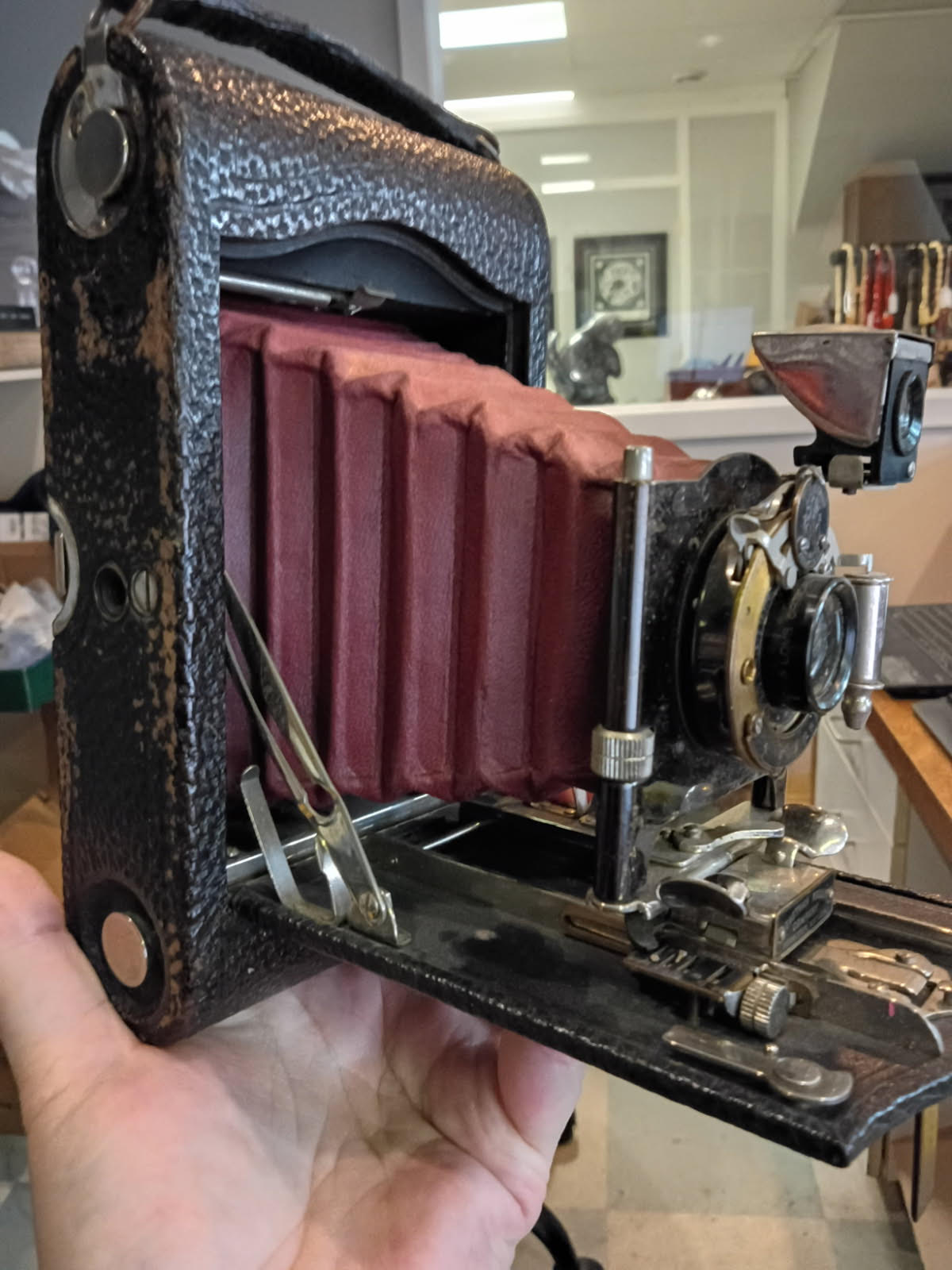
Not sticky. Stuck. The back panel, the part that comes off to load the film, was pushed partway out and would not move. It wouldn’t come out the rest of the way. It wouldn’t go back in. I’ve opened a great many old cameras and I had never felt one fight like this. Something was wedged in there.

When we finally got it open — and it took some doing — this is what was waiting inside the film chamber: a little wooden case, wrapped up in a dark red man’s handkerchief. Someone had hidden it in there deliberately, pushed the back cover of it to close it, and the two had been locked together so long and so tight that the camera had all but sealed itself shut around its secret.

Inside the little wooden case was a ring.

What the ring was

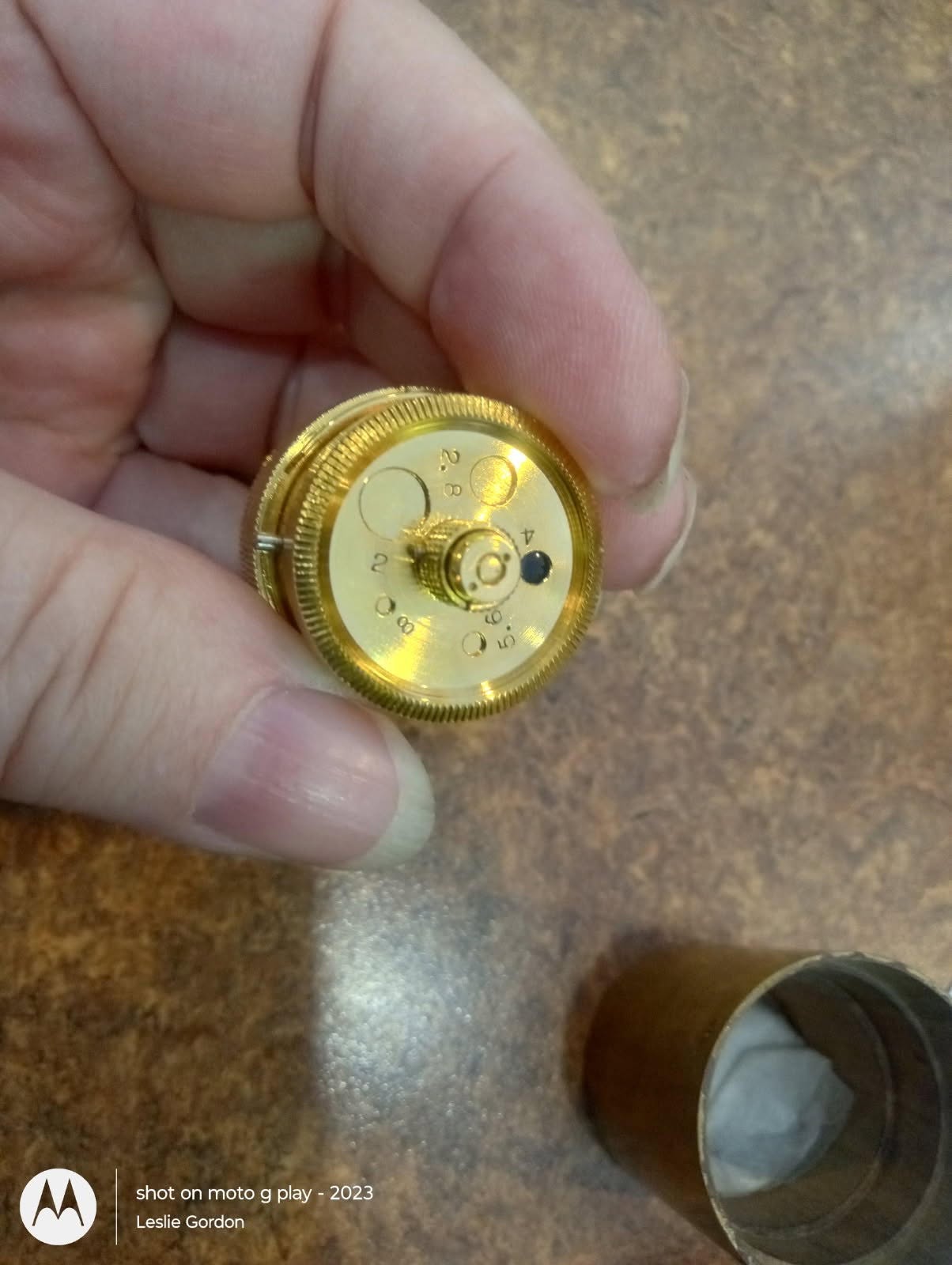
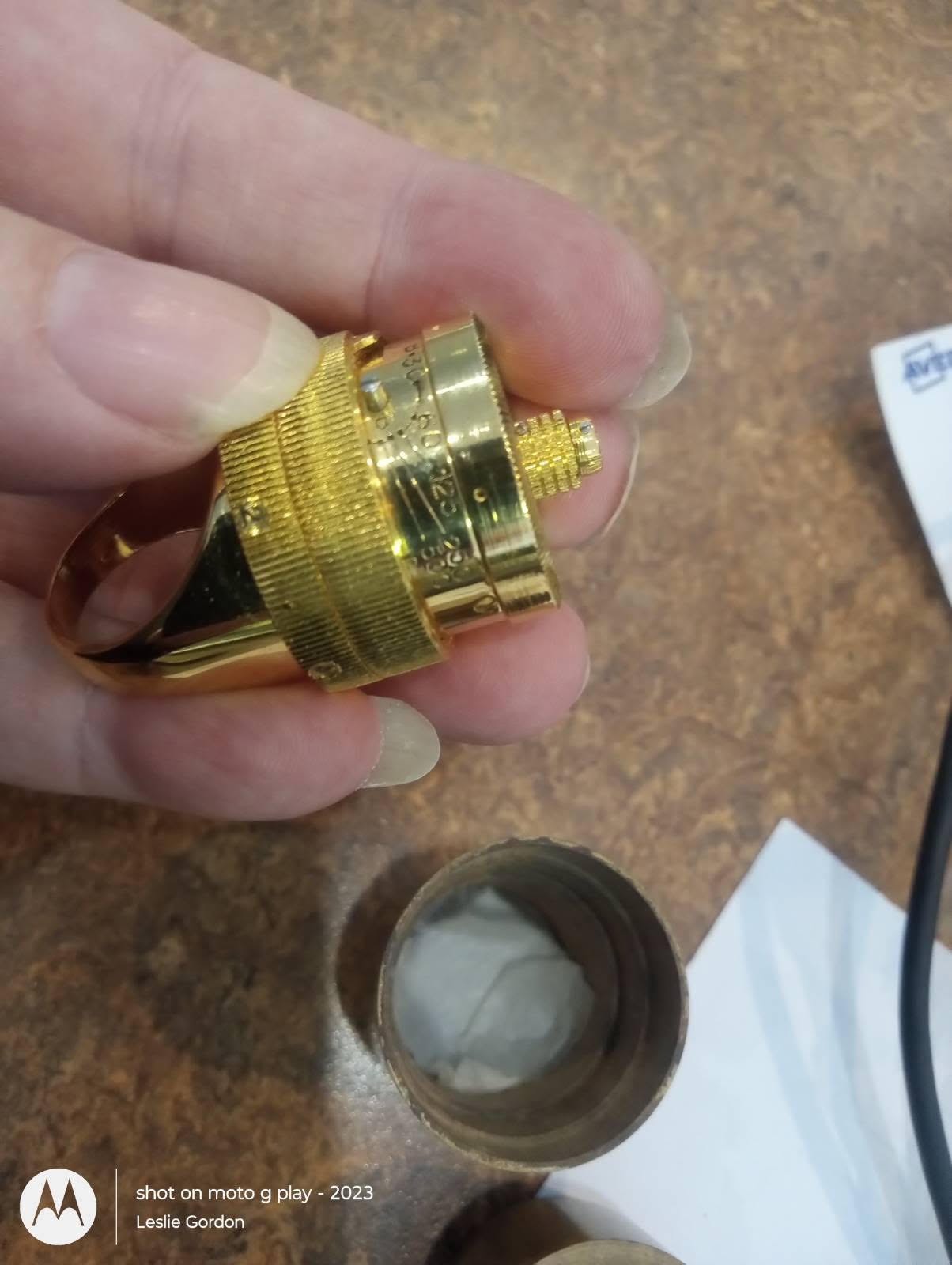
It looked, at first, like a heavy novelty ring. Gold, chunky, a little strange. But turn it over and there were numbers and dials worked right into the band — tiny aperture stops, shutter speeds. Not a ring pretending to be interesting. A real, working subminiature camera, built to be worn on a finger. A camera, in other words, hidden inside another camera.
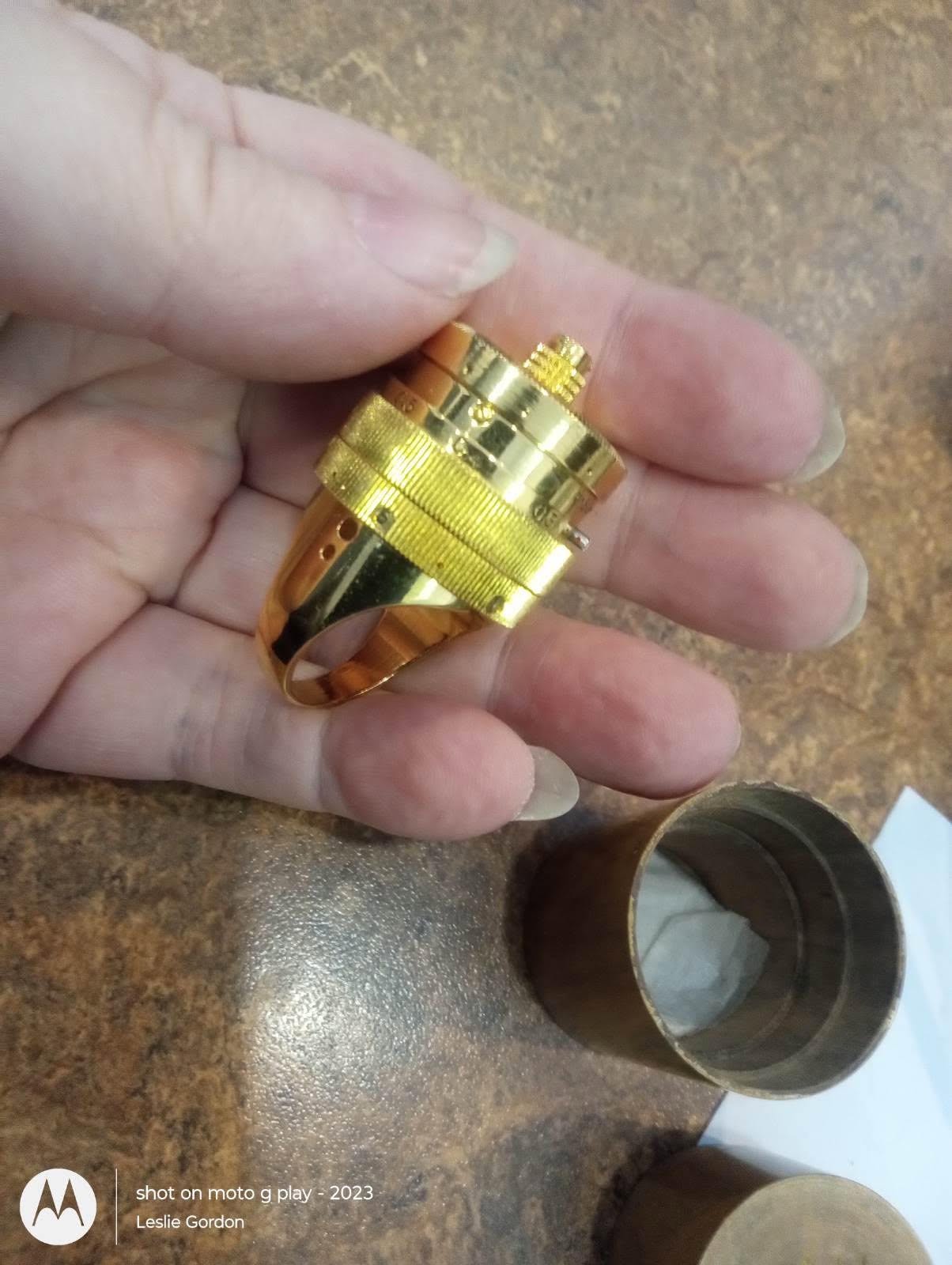
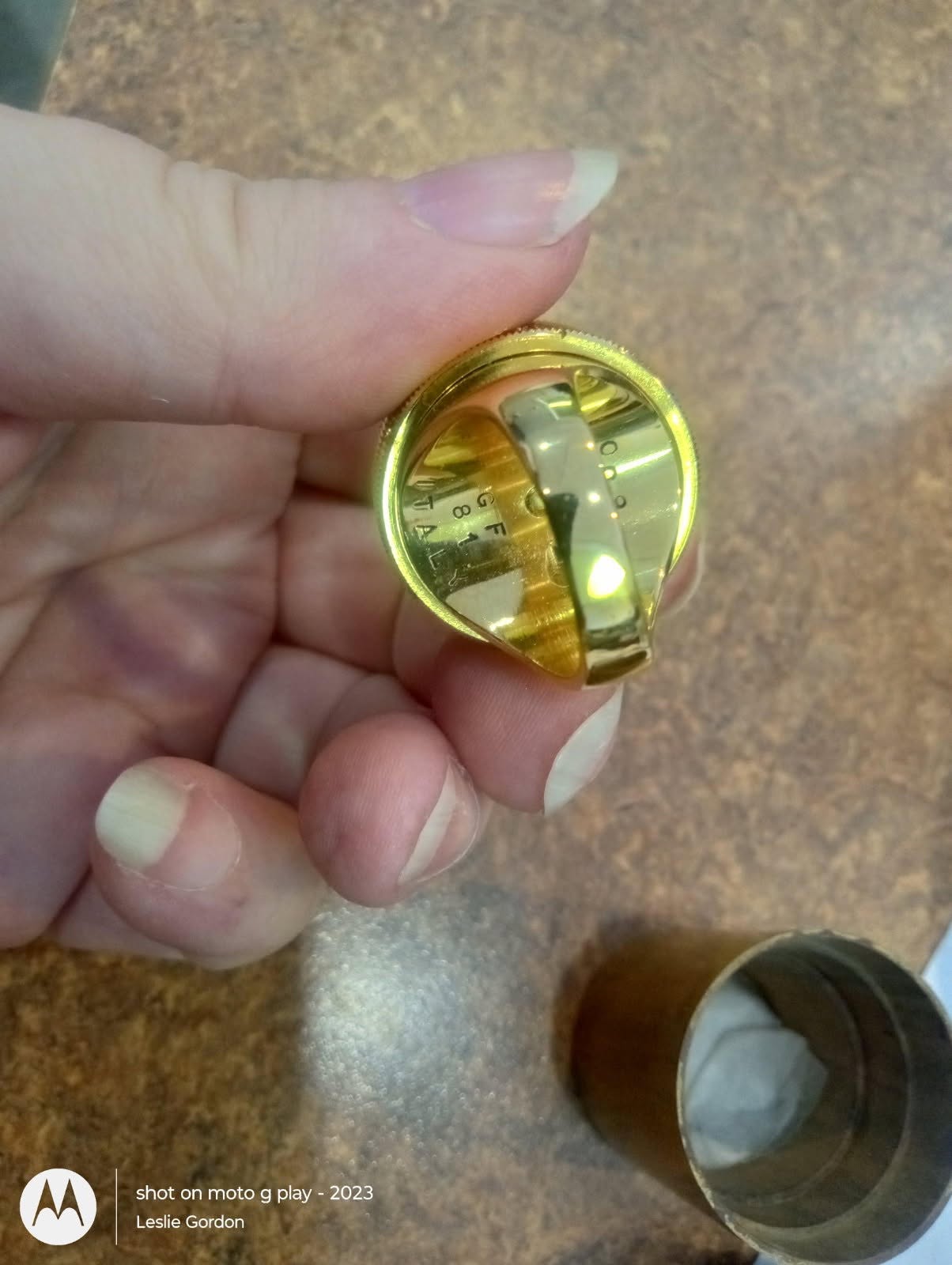
What it did not have was a name. No tidy maker’s plaque, no note tucked in with it to say who or why. Just a mark cut into the band and the storage cylinder:

GF 81 ITALY Maker’s initials · Year · Country

Two letters, a year, a country. That’s the whole of what the ring would tell me outright. GF for whoever made it. 81 for 1981. ITALY for where. And a number — this one is 9 of 20 — meaning it belonged to a numbered edition, something made in a deliberately small run rather than by the thousand.

Which already raised a quiet little problem. The camera it was hidden inside is from about 1911. The ring is from 1981. Seventy years apart. Whoever did the hiding did it in my lifetime, not in some sepia past — chose an antique camera, three generations old even then, as the place to tuck something away. I find I can’t stop thinking about that, and I have no way to know the rest of it.

The hunch

Here is the part I’ll be honest about, because honesty is the whole job. I had a feeling about those two letters. Not evidence — a feeling, the kind you get after enough years of handling things. I was fairly sure GF stood for a particular maker. But a feeling is not something you can put on a tag or tell a buyer. In this trade, “I know it in my heart” and “I can prove it” are two different objects, and only one of them is worth money.
So the rule I hold to is simple: follow the marks until they either confirm the hunch or kill it. The marks are allowed to lead. The hunch is not.

The marks led somewhere.

What the marks confirmed

It turns out there is a documented record for exactly this object. The first ring camera of its kind was made in Italy in 1981, in an edition of just twenty pieces, gold-plated and numbered 001 through 020. The two letters cut into the band are the initials of the man who made it: Gianpaolo Ferro.

Everything on the ring lines up with that record — the GF, the 81, the Italy, the number inside a run of twenty. The hunch and the documentation arrived at the same door at the same time. That’s the moment a feeling becomes a fact you’re allowed to say out loud.

Ferro went on to make other versions over the following years, but only ever 107 of these ring cameras across his whole career, start to finish. Twenty of them were that first 1981 batch. This is one of those twenty.
What the ring is

Maker Gianpaolo Ferro, Italy ModelGF81 ring camera Year1981 EditionNo. 9 of 20 Finish Gold-plated Function Working subminiature camera — real aperture & shutter settings

Why a camera in a ring

The idea isn’t as far-fetched as it sounds. For most of the twentieth century, if you needed to photograph something and could not be seen doing it, the camera had to disappear. It went inside matchboxes, cigarette cases, pocket watches, wristwatches — and, yes, gold rings. The whole craft was making the machine vanish into an ordinary object.

So a camera worn on a finger belongs, at least in spirit, in a Cold War spy story. I want to be careful with that, the way I’d want any dealer to be careful with me: I can’t tell you this particular ring was ever carried by an agent or used in the field. What I can tell you is what it is — a genuine, working, finger-worn camera from 1981 — and let the imagination do the rest.
What we’ll never know

Here is the part I can’t answer, and won’t pretend to. I don’t know who hid the ring inside that camera. I don’t know why. I don’t know whether it was squirrelled away from a thief, a spouse, a government, or simply from the ordinary forgetfulness of a crowded drawer. I don’t know whose dark red handkerchief that was, or whether the person who wrapped it meant to come back for it and never did.

And I’ve decided I’m glad I don’t. A dealer is always tempted to tidy a story up — to supply the ending the object seems to be asking for. But the honest version is better than any I could invent: a working spy camera, sealed for who-knows-how-long inside a hundred-year-old Kodak, wrapped in a stranger’s handkerchief, and no one left to tell us the rest. The mystery is the inheritance. I’m the one who happened to open the box.

What I can say, I’ve said plainly — and every word of it is first-hand. The camera that wouldn’t open. The forcing of it. The little wooden case and the red handkerchief. And two letters that, followed patiently, turned out to name a man and a year. If I’d shelved the ring as a novelty, GF would have stayed GF (and meant gold-filled). The whole difference between “odd gold ring” and “documented 1981 Ferro, nine of twenty” was treating a small thing as a question worth asking.

That’s the quiet pleasure of this work. The thing in your hand is always trying to tell you what it is. Most days it manages only a word or two. My job is to take the word or two seriously enough to find out what it was trying to say — and to know when to stop, and let the rest stay a mystery.

Going to auction…

This one is at Harrington’s

Not ours to sell this time — the ring is consigned to Harrington’s Fine Jewellery Auction, and it goes to the block with its little wooden case.

Lot 92, closing Friday, October 16.

Phone 1-800-359-9021
bid.harringtonsauctions.com — search “spy camera ring,” Lot 92

A spy camera that turned out to be real — hiding, all along, behind two little letters.

Leslie · The Pound & the Provenance · 778-708-0454
The Lady on the Gentlemen’s Shelf

There is a case in the back of my shop that most people never see. The room it lives in is only half finished, so I keep the door shut and take folks in myself — which means by the time someone is standing in front of that case, we both know they are a serious person. The repeat offenders, I call them. You know the type. You are the type, or you wouldn’t still be reading.

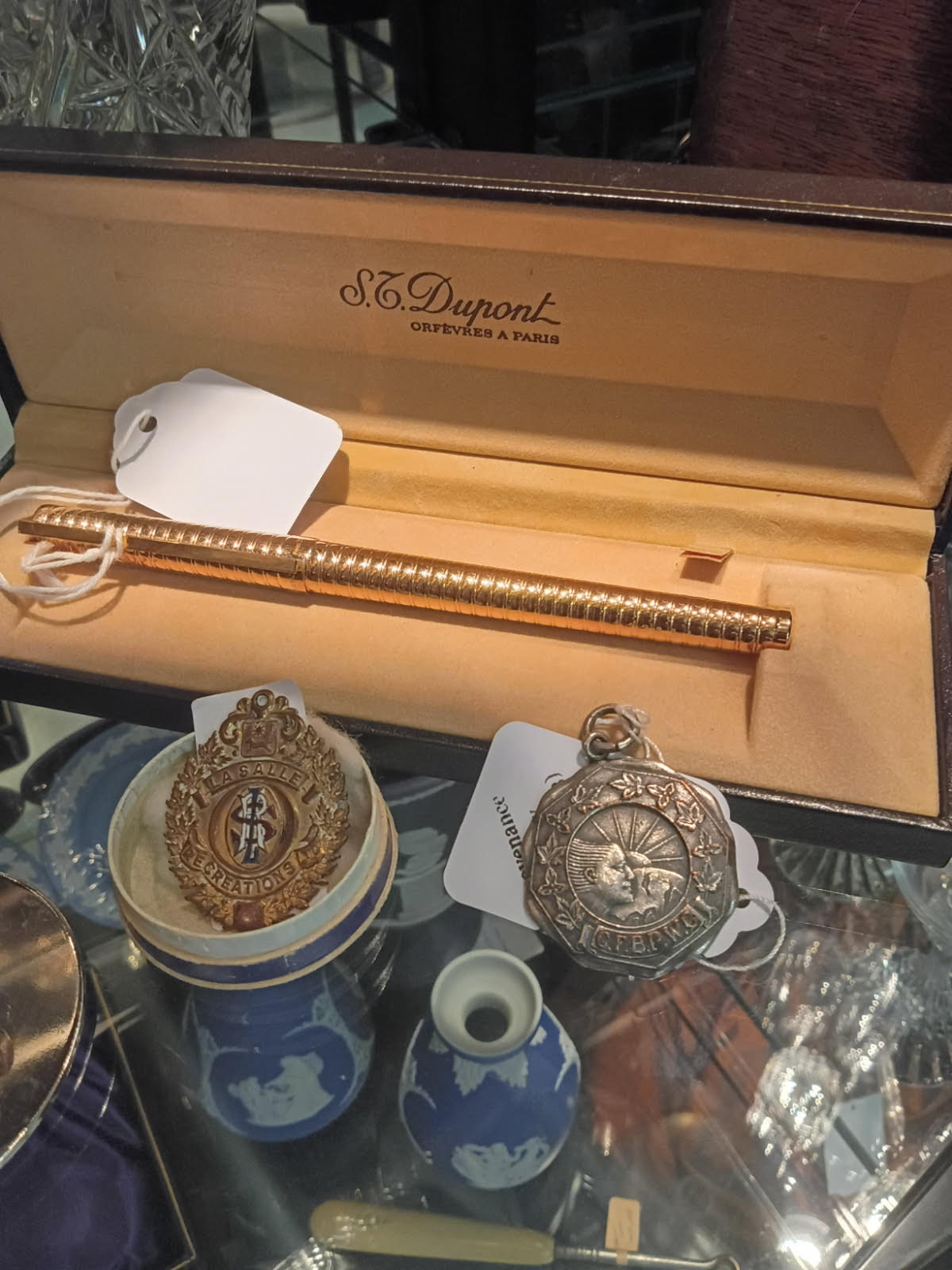
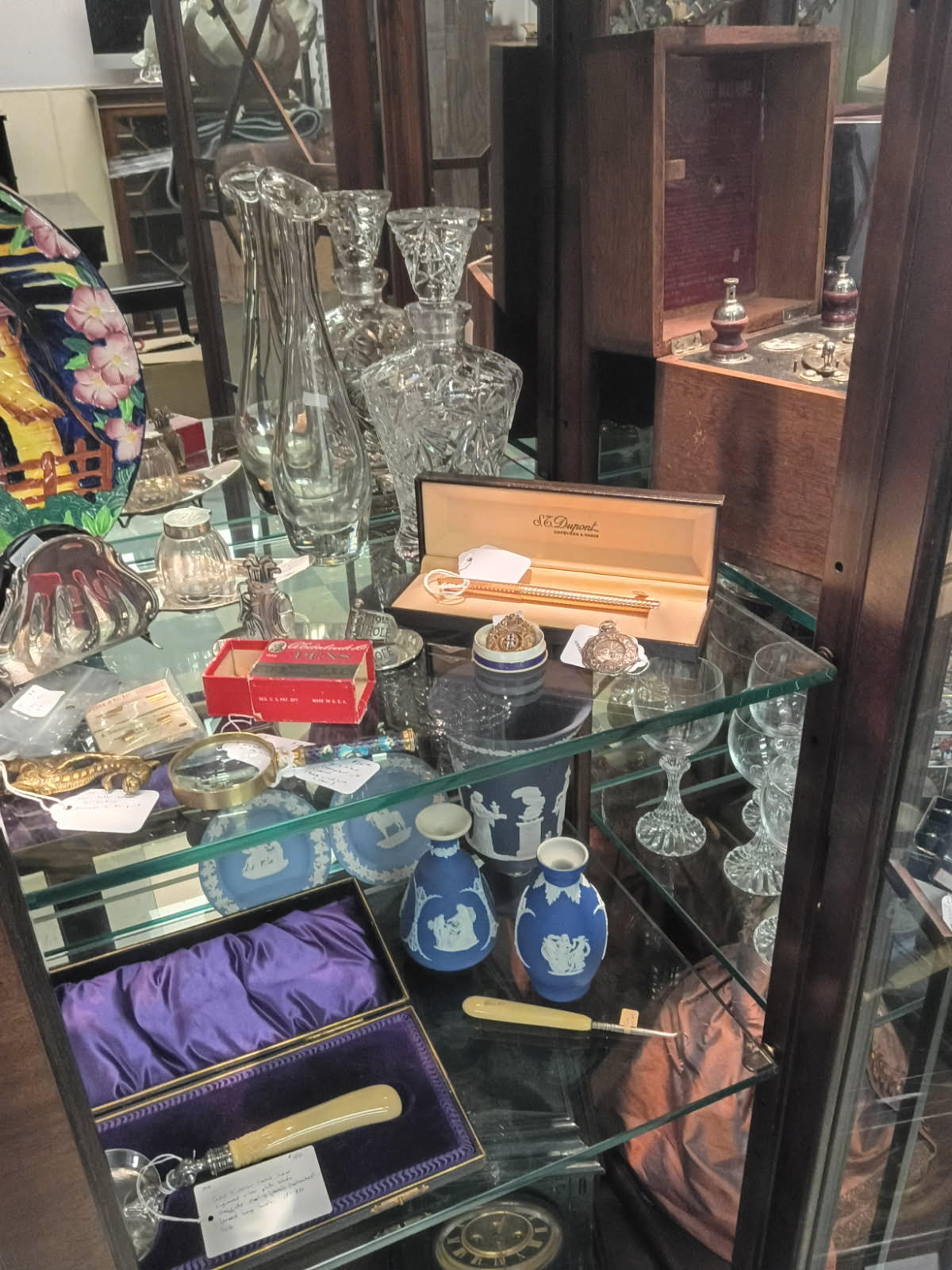
The shelf is a gentlemen’s affair. An S.T. Dupont pen lying in its Paris box. Cut crystal. An inkwell. Pocket watches. A little brass crest from La Salle. It is the sort of collection a certain kind of man assembles on a certain kind of desk, and it photographs beautifully.

And tucked right in the middle of all that masculine ceremony is a small, dark, worn-out disc about the size of a nickel-and-a-half, that I put there entirely on purpose.

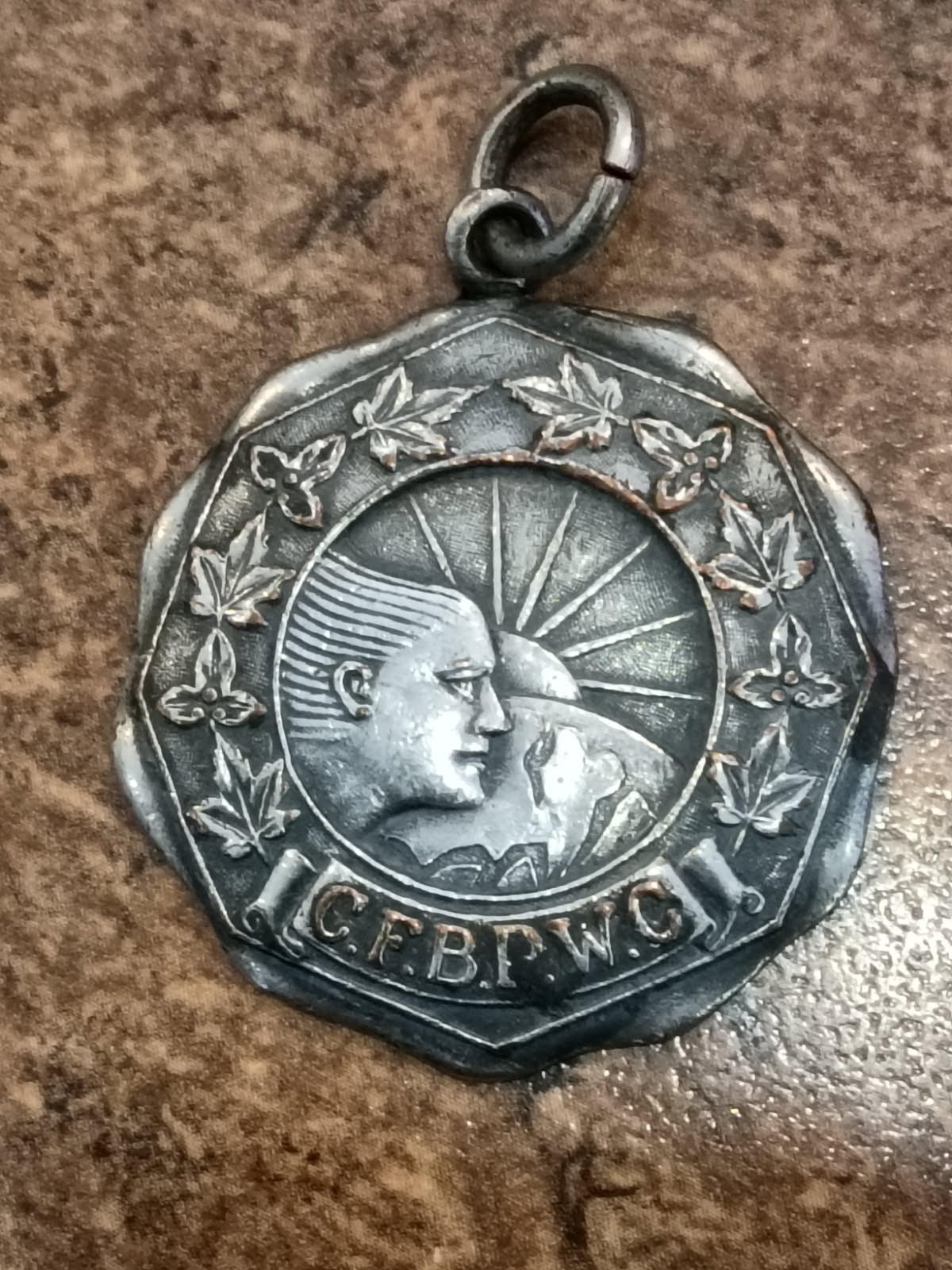
It is a medal. Silver plated — and I’ll be honest with you, the plating has given up in places and worn through to the copper underneath, with a few green freckles of age where the two metals have been arguing for ninety years. It is not valuable the way the Dupont is valuable. You could hold it and think well, that’s seen better days, and set it back down, and I would not blame you.

But turn it over and squint. The maker’s mark reads J.R. Gaunt — a British firm that stamped out cap badges and club medals by the barrowful, with a hand in Montreal. (The McCord Museum in Montreal has drawers full of the work, if you’d like to fall down that particular hole — I’ll wait here.) So half the regimental badges and society fobs in this country passed through their dies. And the front, under a little rising sun with maple leaves and Ontario trilliums around the edge, carries six initials: C.F.B.P.W.C.

The Canadian Federation of Business and Professional Women’s Clubs.Founded in 1930 — which drops them into the long quiet between the first wave of the women’s movement and the second. (They’re still going, by the way.) Working women — at a time when the phrase itself was still an argument — banding together for equal pay and a seat at the table, decades before that fight had a tidy name. The style of the thing says 1930s or ’40s to me, which puts it right at the founding. So while all those gentlemen’s objects were sitting on their desks being important, this is what the women were doing.

I don’t know whose it was. Somebody earned it, or was given it, or wore it to the meetings where the resolutions got written. I like to think she’d be quietly pleased to find herself here — the one working woman in a case full of men’s things, not asking permission, just in the room. Seemed to me exactly where she belonged.

She’s not for sale to the first person through the door. But if you ask to see the back room, and you pick her up, and you turn her over — well. We’ll have something to talk about.

Leslie
778-708-0454

The Pound & the Provenance
7791 Steveston Highway
(northwest corner of No. 3 Road and Steveston Highway)
Richmond, BC, Canada

~~~

Please Note: I am not an appraiser, a silversmith or a gemologist. I am an antiques dealer. A generalist with a love for things with a bit of age. I had a stroke, four years ago, and AI is helping me to do better than I would have. Nothing here is false, everything here is true. I hope you enjoy it and please leave a message.

Ref. no. 1191


Everybody pets the cranes.

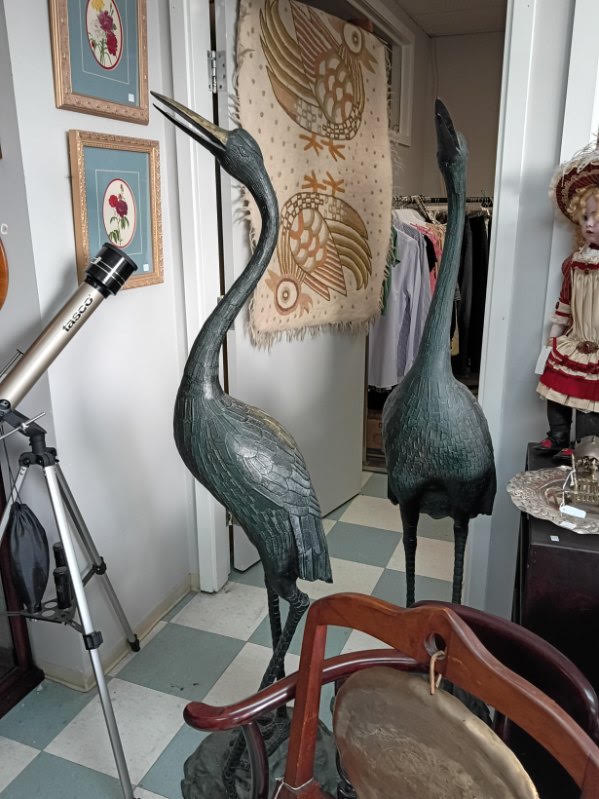
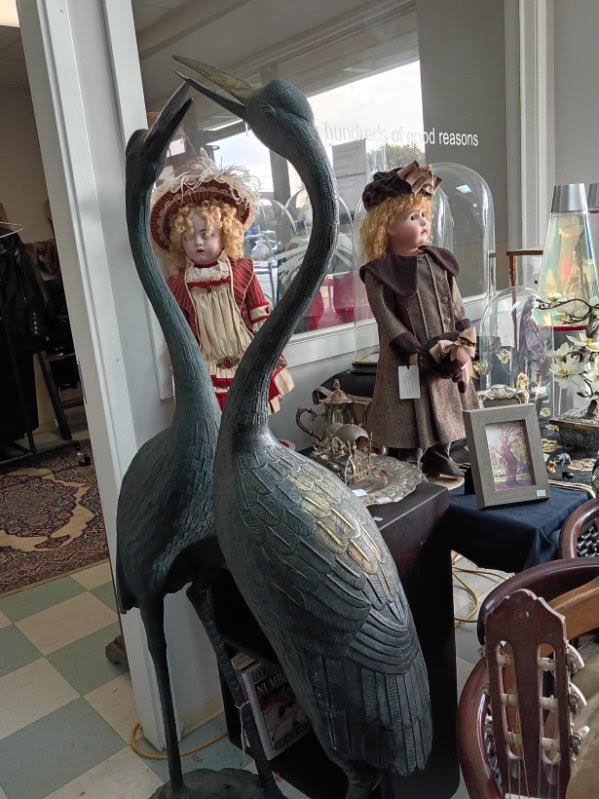
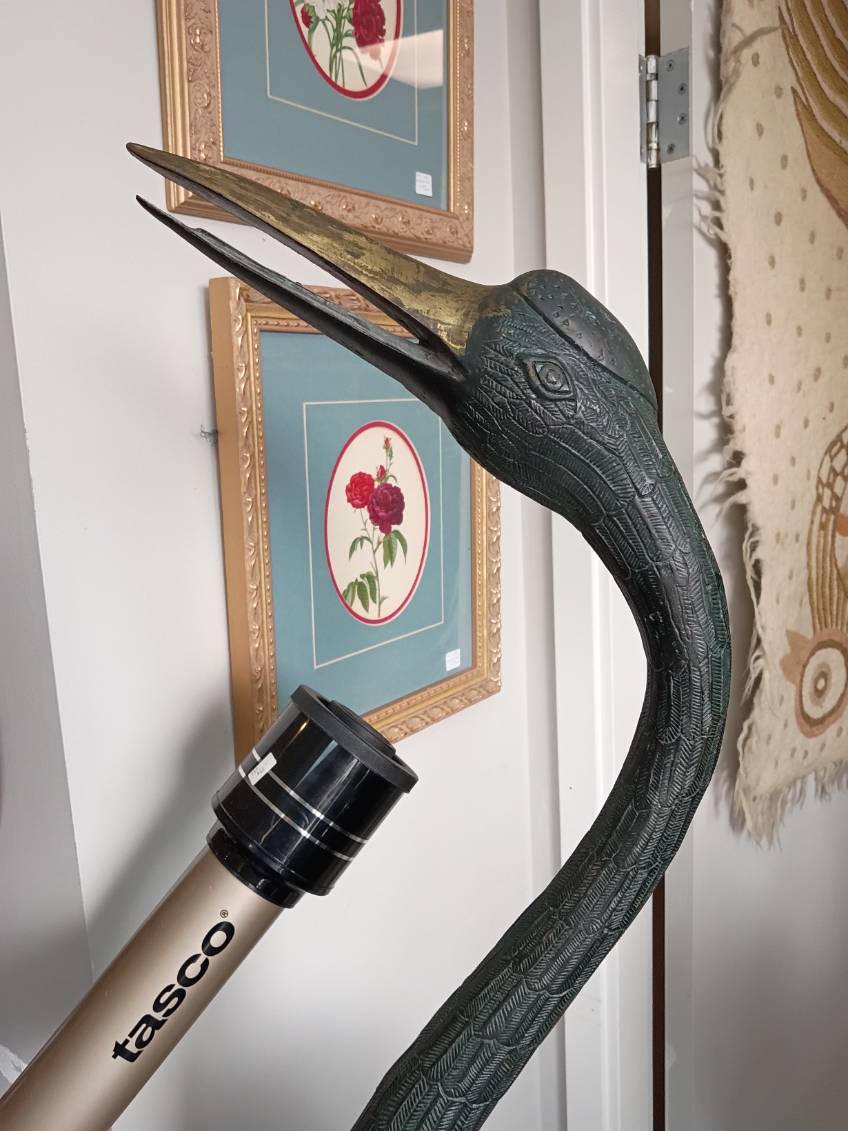
I don’t know when it started. Someone reached out on their way past, gave a wing a pat, and somehow it became a thing everyone does. Kids. Regulars. People who’ve never bought a thing in their life but always say hello to the birds. You can see exactly where it happens — the bronze has gone soft and green everywhere the weather touched it, except down their backs and along the beaks, where a thousand hands have kept the brass glowing warm and gold.

They’re a matched pair — identical, two tall cranes standing just over five feet, heads raised like they’ve heard something interesting across the room. They’re made the old way, brass and bronze together: the brighter brass catching the light at the beak and the high points, the darker bronze going that deep even green over the rest.

They spent years out in a garden — a sheltered patio — and you can read every one of those seasons in the patina. That soft, even green is the honest gift of real time outdoors: sun and damp and frost doing their slow work, a little at a time. It’s the kind of surface you simply can’t rush or fake.

There’s a reason cranes so often come as a pair. In both Chinese and Japanese tradition they stand for long life and good fortune — and because real cranes are said to mate for life, a pair has always meant faithfulness, two together for the long haul. These two have kept each other company a good while already.

I’d love to see them go somewhere with room to stand sentinel: flanking a gate, watching over a pond, guarding a doorway. They weigh about a hundred pounds apiece, so whoever takes them is making a commitment — but a pair like this is the kind of thing a garden keeps for fifty years.

They’re in the shop if you’d like to come say hello before they find their garden. Message or call.

Leslie
778-708-0454

The Pound & the Provenance
7791 Steveston Highway
(northwest corner of No. 3 Road and Steveston Highway)
Richmond, BC, Canada

Please Note: I am not an appraiser, a silversmith or a gemologist. I am an antiques dealer. A generalist with a love for things with a bit of age. I had a stroke, four years ago, and AI is helping me to do better than I would have. Nothing here is false, everything here is true. I hope you enjoy it and please leave a message.

Ref. no. 234

A Cat and Four Kittens

Some pieces give themselves up at a glance. This one made me work for it — and then rewarded the work.

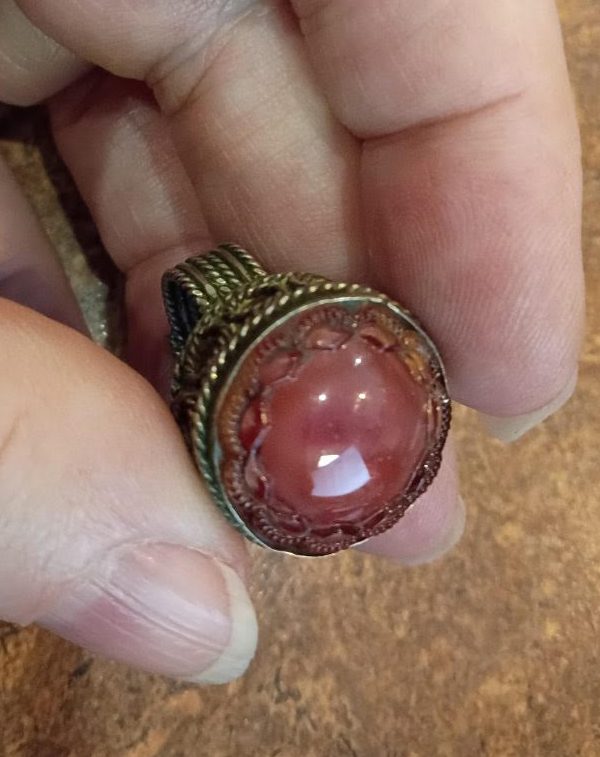
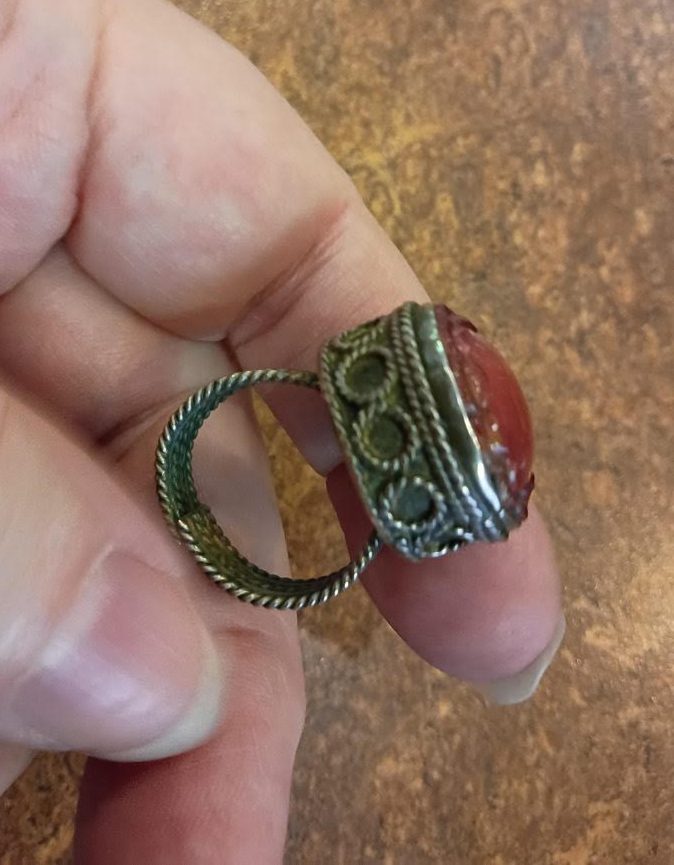
It’s a tribal silver ring, the kind made across Afghanistan and Central Asia: you can read the hands all over it. Wire twisted into rope, laid beside plain wire; little applied circles or coils around the shoulders; a tall domed cup — the bezel — rising up to cradle the stone. None of it stamped, none of it identical side to side. That’s the signature of tribal silverwork — made one at a time, by eye, by hand.

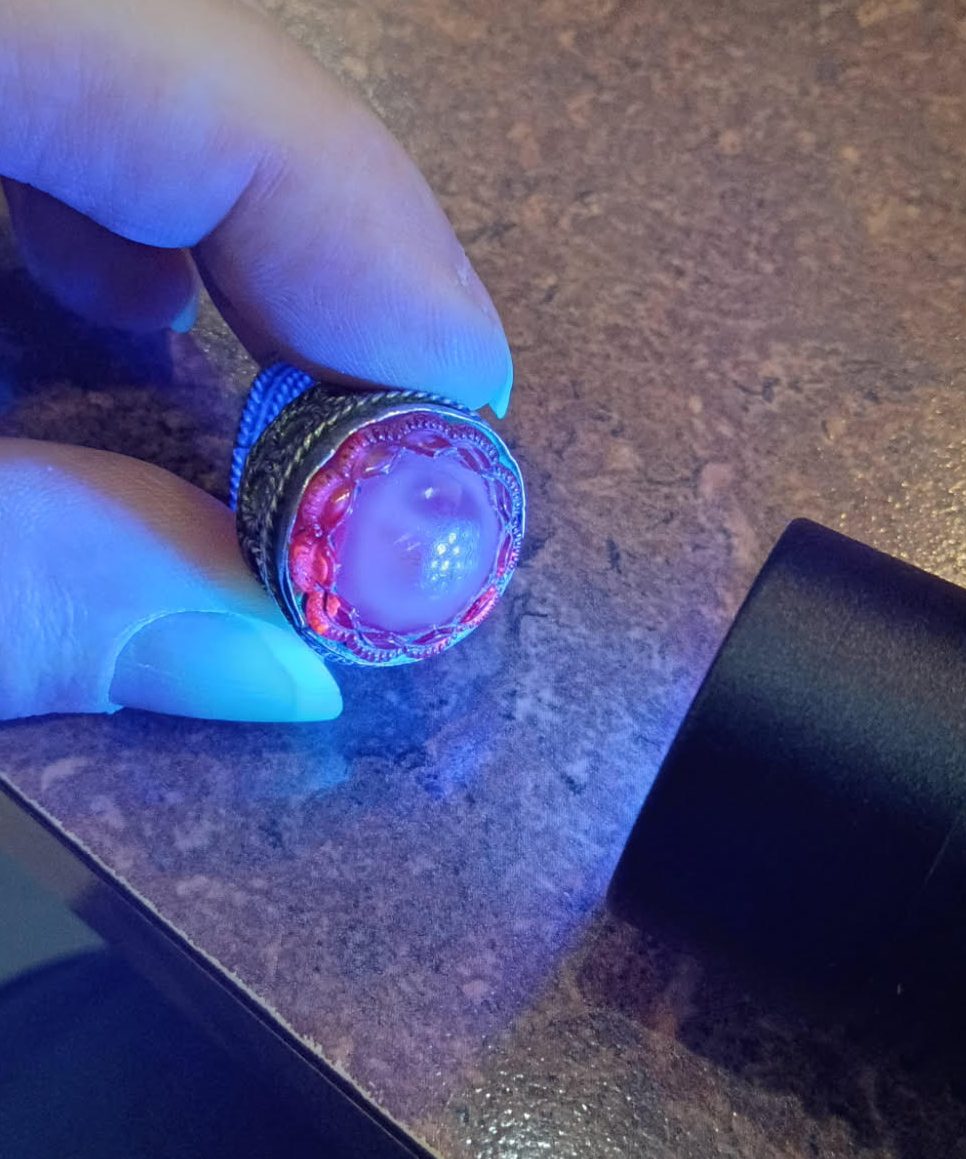
The stone is a banded chalcedony — a cousin of agate — in a warm carnelian-pink. Its colour has very likely been warmed up, which is the usual way with these tribal rings and no mark against it; the old workshops did it as a matter of course. What can’t be faked is the way it’s chatoyant — tilt it to the light and a soft band of brightness, a cat’s-eye, slides across the dome. It’s a gentle one, not a sharp knife of light, and all the lovelier for it. On one side there’s a clear pink band you can see with the naked eye; on the other, just a trace.

And here’s the fun part. The carver didn’t stop at one dome. Out of a single stone they shaped a big central cabochon, ringed by eleven small carved domes — twelve in all. But tilt them to the light and only four of the little ones answer back, each catching the same soft cat’s-eye as the big center stone. Twelve domes, and you have to hunt for the four that are hiding a cat’s eye. A cat and four kittens, hiding in plain sight.

Sit with that number a moment, because twelve is no small thing in the part of the world this ring comes from. Twelve months, twelve signs of the old zodiac that the astronomers of the Islamic world studied and refined; and in the Shia tradition that runs through Afghanistan and Iran, the Twelve Imams. A central figure encircled by a ring of others — the one and the many, the sun and its attendants — is one of the oldest patterns people have ever arranged things into. I can’t tell you the carver meant any particular one of those. But twelve is a number with weight here, and whoever made this chose it.

And then there’s the eye itself. Across Central and South Asia, a cat’s-eye stone wasn’t only pretty — it was a guardian. The “eye” in the stone was thought to watch, to turn away the evil eye, to keep the wearer safe. So this is a ring that, by old reckoning, has a dozen eyes looking out for you — five of them awake and shining.

What I keep coming back to, though, is simply how hard this was to make. One piece of chalcedony, and someone sat and carved twelve separate domes into it by hand — no machine, no shortcut — and shaped them so cleanly that four came out chatoyant, each with the light rolling across it just so. That’s patience I can barely imagine. The kind of slow, exacting handwork that nobody does by accident.

It wears honestly — the small irregularities of hand-work, the wear you’d expect from a ring that’s lived a life. Size 6½, and the shank is cut in the traditional way so it flexes about a quarter-size smaller or larger to settle on the finger.

$85. It’s in the shop. Come tilt it to the light yourself — a photograph can’t quite catch a cat’s eye moving — or message / call 778-708-0454.

Leslie
778-708-0454

The Pound & the Provenance
7791 Steveston Highway
(northwest corner of No. 3 Road and Steveston Highway)
Richmond, BC, Canada

~~~

Please Note: I am not an appraiser, a silversmith or a gemologist. I am an antiques dealer. A generalist with a love for things with a bit of age. I had a stroke, four years ago, and AI is helping me to do better than I would have. Nothing here is false, everything here is true. I hope you enjoy it and please leave a message.

Ref. no. 1159