Category Archives: Economics

Thoughts on the Kinder Morgan Pipeline Project…

This last semester, I took a course called, “Sustainable Human Economy.”  It was not quite the class that I expected it to be but, it was time well spent.  I wrote five very short papers.  Answered questions in an online format.  Gave a presentation with a partner.  Found myself slightly distressed at the level of misinformation that is out there, that many of the other students are holding as truth.  Found a little more distress at the lack of consilience that I was encountering.  Knowledge that should be easily drawn upon, I thought, was for the most part, absent in the classroom.

It takes a lot of reading to gain an insight — not an understanding, an insight — into so much of what is happening in this world.  I have been reading since I was very young.  Sometimes it is a popular novel (the literature of the future), sometimes textbooks (learning from the literature of the past) and sometimes, peer-reviewed articles (I find that these often contain phrases of inspiration and meanings past what the authors are trying for).  I look up song lyrics, sermons, poetry and plays.  I find my Condensed Oxford English Dictionary fascinating.  I find it to be a bit depressing that the university I attend does not have a physical copy of the OED.  I tutor ESL and writing at my university and I would love to walk people over to the OED and look up first instances and changes in meanings….

One of the papers that I wrote for the “Sustainable Human Economy” course was on a proposed oil pipeline.  I asked friends to give me their honest opinions on this essay and, they have!

What I talk about in this essay is responsibility.  The following essay is not about me being against pipelines (because I am not against pipelines).  It is not about jobs or a loss of jobs or deforestation or sustainability or the GDP.  This essay is simply about responsibility.


Kinder Morgan Pipeline Project Questions:

“On Dec, 16, 2013, Kinder Morgan submitted an application to the National Energy Board (NEB) to expand the Trans Mountain Pipeline, which would almost triple oil capacity from 300,000 to 890,000 barrels per day in pipelines running from Alberta oilsands to the Westridge Marine Terminal in Burnaby.  The company is seeking approval from the NEB.  All British Columbians who live, work and own businesses on the west coast will be directly impacted by the outcome of the decision whether to expand the pipeline.

Try to answer the following questions.  Try to get evidence to support your case.

  • Briefly outline the pipeline history and provide some details of the proposal[.]
  • Discuss some of the potential economic benefits of the project to our local economy.
  • Who will this project benefit and who will it put at risk?
  • Describe the potential impact of the project on ecosystem sustainability[.]”  (copyright Kwantlen Polytechnic University, Prof. A.B. Demeke)


A Brief History:

In 1952, an oil and gas pipeline was built by the BC Gas Company to bring crude oil, gas and jet fuel from Northern Alberta into British Columbia, to refineries in Greater Vancouver and Washington State.  This pipeline was built  to deliver products that were needed locally.  Kinder Morgan purchased the BC Gas Company in 2005 and began small expansions of the pipeline that included the construction of new pumping stations (Dhalwala, et al), almost immediately.

In 2013, Kinder Morgan filed a request to be allowed to expand the existing pipeline system to increase the flow of crude oil from a 300,000 barrel per day capacity to approximately 890,000 barrels per day.  If the goal of 890,000 barrels per day cannot be reached consistently, the backup plan is to load oil tankers, further north, along the North Coast of British Columbia.  In 2012, more than a year before the official request for the required permits for the expansion was presented to the province of British Columbia, Kinder Morgan was asked by the province to provide them with documentation of the following:

  • Successful completion of the environmental review process… a positive recommendation by the Board;
  • World-leading marine oil spill response, prevention and recovery systems for B.C.’s coastline and ocean to manage and mitigate the risks and costs of heavy oil pipelines and shipments;
  • World-Leading practices for land oil spill prevention, response and recovery systems to manage and mitigate the risks and costs of heavy oil pipelines;
  • Legal requirement regarding Aboriginal and treaty rights are addressed, and First Nations are provided with the opportunities, information and resources necessary to participate in and benefit from a heavy-oil project; and
  • British Columbia receives a fair share of the fiscal and economic benefits of a proposed heavy oil project that reflects the level, degree and nature of the risk borne by the province, the environment and taxpayers. (Hearing Order)

The province of British Columbia was supplied, not with documentation giving  details of the preceding requirements but, with “heavily redacted Emergency Management Program documents… [that] do not enable the Province to determine whether Trans Mountain is prepared and able to respond to a Project-related spill” (Hearing Order).  “The proposal is designed to export oil sands products to foreign markets.  As a result, the pipeline is not required to meet domestic fuel needs.”  (Dhalwala)

The record of the court proceedings between The National Energy Board of Canada, The Province of British Columbia, and Kinder Morgan go into great detail in regards to the lack of detail that Kinder Morgan has provided to the Province over the four year period that this issue has been in front of the provincial and federal courts.  The province states that they can only act on the information that has been provided to them and what was provided was not what was asked for.


Economic Benefits and Risks to British Columbia:

Short term benefits of the expansion of the Kinder Morgan pipeline will include construction jobs.  Over the term of the project various trades will be brought in to facilitate construction.  Kinder Morgan’s reputation is such that it is unknown whether local trades will be hired or if foreign workers will be brought in for the expansion project.  At the end of the project it is estimated that only 50 permanent jobs will be created (Dhalwala, et al).

Since 1952 there have 78 oil spills in British Columbia.  The four most recent oil spills have been in the Lower Mainland and Fraser Valley Regions of the province.  Three spills have been leaks in the current pipeline and one was a leak from a seal in a tank.  The amount of oil spilled was well over 1 million litres (Dhalwala).  This is not much more oil than what just one of the new oil super freighters that Kinder Morgan will have traveling along the coast of British Columbia and into the ports of the Greater Vancouver Regional District will be carrying.


Ecosystem  Sustainability Impacts:

On November 13, 2015, Justin Trudeau, Prime Minister of Canada, instructed Marc Garneau, Minister of Transport, to: “Formalize a moratorium on crude oil tanker traffic on British Columbia’s North Coast…”  This moratorium only affects the north coast of British Columbia, not the West Coast where most of the tanker traffic for this project will be situated.  Further, I do not know whether the moratorium has been formalized or not.  I was unable to find more information or to clarify my questions as to what has been done in this regard.

The coasts of British Columbia are home to some of the most diverse and productive marine habitats in the world.  Kinder Morgan’s reputation is one of non-responsibility.  They have received “strong criticism” for their lack of attention to leaks and to clean up efforts (Dhalwala, et al).  In a major oil spill, they would be responsible for clean up to a maximum of 1.34 billion dollars (Dhalwala, et al).  Major oil spills have cost 10 times that amount to clean up and Canada does not have the capacity to deal with major spills in a timely or effective manner (Dhalwala, et al).  This is one of the many reasons for the proposed moratorium on tanker traffic on the north coast.  We just don’t have the means to be responsible for what can happen.

On the Kinder Morgan, Trans Mountain Pipeline information website, Kinder Morgan states that they are responsible for, “reporting spills greater than 1.5m3 or any spill to a water body regardless of volume.”  The page goes on to define “[a] spill or release… [as] a discharge, spray, spill, leak, seep, pour, emit, dump and exhaust” of products being transported.  “That means if water is released from a pipeline or facility, that incident is also reported.”  However, in 2007, a spill at the Sumas Tank Farm in the Fraser Valley went unreported because “the Sumas pump station was not part of a leak detection system” (Dhalwala, et al).

Kinder Morgan’s responsibility for the products they are transporting ends as soon as the product has been loaded onto a receiving vessel.  The University of Victoria studied “ship source liability” and found that cost recovery for a major spill, from the international companies owning these ships, whether in Canadian waters or at sea, would be difficult even if the ship’s owners were found to be at fault (Dhalwala, et al).   The University of British Columbia (UBC)  looked at direct costs and the economic impacts of a major oil spill on British Columbia’s north coast.  Regional economic impacts could be in the range of $189 million to $380 million with estimated direct clean-up costs of $2.4 billion to $9.4 billion (Dhalwala, et al).  The Department of Ecology in Washington State estimates that a major oil spill could up to $10.8 billion (USD) and “adversely affect 165,0000 jobs… in addition to direct clean-up costs” (Dhalwala, et al).  Kinder Morgan’s financial responsibility ends at $1.34 billion.

The Port of Vancouver trades in excess of $74 billion worth of goods each year (Dhalwala, et al).  A major oil spill would partially or even fully close the port for an undetermined length of time while clean-up took place.  UBC only looked at the possible costs of an oil spill along the north coast of British Columbia.  Away from the Port of Vancouver, there is a local fishing industry that adds more than $1 billion a year to this province’s economy.  I could not find authoritative information on how an oil spill might affect the fish and the fishing industry of British Columbia or Washington State.

Long term effects of oil spills are only now beginning to be realized.  Clean-ups involve what we can see.  Oil dispersants used to clean up oil spills creates gel-like blobs of oil that are easier to collect.  These blobs have a tendency to sink and therefore, to be out of sight, quickly.  Thirty to fifty years later, these blobs of oil are still being found in the silt and sand of river bottoms and along coastlines where there is a history of oil spills.  Out of sight is not good enough.  We are now beginning to see and study the environmental impacts of the lack of proper containment and clean-up.  There are many unknowns and many more unforeseen consequences of our actions.


Conclusion:

Canada cannot afford to export bitumen to foreign buyers.  At this time the possible risks and associated costs to British Columbia, and to Canada, far outweigh any benefits.  Mining the tar sands of northern Alberta has been a boon to the Alberta economy.  Fish, wildlife and forestry have been the historic boon to the British Columbia economy.  British Columbia seems to be looking to emulate the Alberta economy by piggy-backing on the sale of bitumen.  But the entire benefit to British Columbia is 50 permanent jobs.  The sale of bitumen is being made in Alberta and the tax credits that will come to British Columbia do not seem to even have been worth calculating.


References

Dhalwala, M., Frank, E., Frank-White, R., la Porta, D., McDowell, L., Shende, B., Stafford, T., and Sumaila, R., 2013.  Assessing the risks of Kinder Morgan’s proposed new Trans Mountain pipeline.  Conversations for Responsible Economic Development (CRED).  Retreived from http://credbc.ca/wp-content/uploads/201/11/Trans-Mountain-Risks.pdf

Province of British Columbia, 2016.  (2016).  Hearing Order OH-001-2014, National Energy Board:  Final Argument of the Province of British Columbia.  Province of British Columbia. Retrieved from http://www.eao.gov.bc.ca/pdf/BC_NEB_Trans_Mountain_Final_Argument_11Jan2015.pdf

Trudeau, J., 2015.  Minister of Transport Mandate Letter.  Retrieved from http://pm.gc.ca/eng/minister/honourable-marc-garneau


Time, Through the Eyes of a Child and, William Faulkner…

I have been reading lately.  I have been reading a lot, lately….


The Sound and the Fury.  Written by William Faulkner.  First published in 1929.  Free to read online.  Free and available at most public libraries.  Inexpensive at book sales.  Available in used book stores…

I have not actually finished this novel.  It is a very difficult work to read.  I think I could just skim through it and I would know a few names, a few characters.  I can’t do that to this book.

There are no chapters.  There is simply an awareness of others and the unspoken thoughts of one.  It took me a long time to realize this even though the difference between the two modes of communication are visibly apparent (unspoken thought is in italics).  Neither the past nor the future seems to hold any relevance as the present unravels with painful awareness.

The book begins with the unspoken thoughts of a pre-verbal child.  A slow child.  A child not like the others.  Faulkner gave me the opportunity to listen in to this child’s impressions of the world.  To the unspoken needs and desires of one.

About halfway through the book, possibly this is about halfway through a young man’s life, a watch crystal is purposefully broken and the hands are removed.  Time is still running but the ability to count the seconds into minutes, the minutes into hours….  using that watch, has been stilled.  Does time have meaning if you can no longer measure it?

This book has grown difficult again.  I am putting it down, again.  I have not read any of the hundreds of discussions on this book.  I would like to wait until I finish it and come to my own conclusions.  For this reason, Faulker and his boys will have to wait on me.  Time, for the written word may be almost endless.  These words will wait for me….


I found this book, and many more, in a library book sale.  I had purchased other books the day before and was given a paper bag with $5 written on it.  If I came back the next day I could fill my paper bag with paperbacks.  As many as the bag would hold.  They would all be mine for that $5.  I did.  I have found some wonderful books this way.

Library book sales are often run by groups called “Friends of the Library” or a similar name.  Your local library may hold these sales several times a year.  There are many charitable organizations that also hold book drives and book sales.  These are fun events and great places to begin building a library of real books or, adding to your existing collection, with real friends….


Solving for Pattern or, an Economy of Size

I have been reading lately.  I have been reading a lot, lately….  I could not sleep last night.  An old article by Wendell Berry gave me thoughts to consider and apply to my own small business.


Solving for Pattern.  Written by Wendell Berry.  Chapter 9 in The Gift of the Land:  Further Essays Cultural & Agricultural.  North Point Press, 1981.  Originally published in the Rodale Press periodical The New Farm.

Wendell Berry is a farmer and an author.  His writing is thought provoking and disturbing, well written, easy to read and difficult to walk away from…


Wendell Berry has been on my reading list for a long time.  It is time for us to get to know him, now!  Solving for Pattern is a short article that poses questions and discusses the long term meaning of economy.  Not of economics.  Economy.  Economy of size.  Small businesses.  Small farms.

Questions…  I went back to university several years ago.  I thought I just wanted to take a few courses, make my evenings a little more interesting.  I discovered that I was learning to read in a way that I had not even considered possible.  I am still learning about reading but now, I am also reading to learn to ask questions.  Wendell Berry has been asking these questions for a long time.  His questions about patterns, economy, conservation, and healthy living are worth considering.


Further Readings (I have already started reading The Unsettling of America):

Wendell Berry, The Unsettling of America:  Culture & Agriculture.  1977.  Sierra Club Books, San Francisco, 1977.  This book is available in most libraries.  Read a review of this book here.

James George Frazer, The Golden Bough.  First published in 1890.  My edition was published in 1994 by Oxford University Press.  Available online, free, here.


Water Rights & Environmental Damage

I have been reading lately.  I have been reading a lot, lately….  I finished reading this article last night, on the bus on my way home from work.  Yes, I use public transit.  I gave up my personal gas pedal almost 3 years ago.

Water Rights and Environmental Damage:  An Enquiry into Stewardship in the Context of Abstraction Licensing Reform in England and Wales.  Written by Donald McGillivary.  Published by Environmental Law Review, Volume 15, 2013.  Pages 205-224.

Donald McGillivray, Professor of Environmental Law, University of Sussex, has a current publication list here.

I found this article doing a random search on water rights.  I was looking more towards Western Canada, where I live, but all information is good and this article is full of definitions that will probably help me in further reading.  And, bonus marks, Professor McGillivray’s writing is concise and clear.

Probably the most important things that I realized while reading this article was that the environment is not protected by stewardship rights or laws.  That the only time we really protect the environment is when there is an overlap of needs between someone holding water (or land) rights and the environment.  In other words, when it benefits someone to protect something, the environment is looked after.  Not something that I had not realized before but, seeing it in a published article is different.


A couple of ‘Further Readings’ (from the footnotes) that I made note of:

E.D. Elliot, ‘The Tragi-Comedy of the Commons: Evolutionary Biology, Economics and Environmental Law‘ (2001) 20 Viriginia Environmental Law Journal 17, pages 17-18.

C.P. Rodgers.  ‘Nature’s Place? Property Rights, Property Rules and Environmental Stewardship‘ (2009), Volume 68(3) Cambridge Law Journal 550.


National Gallery Postcard, circa 1950’s – van de Velde, Coast Scene: Calm

This is a vintage postcard out of my collection.  I like pieces of paper.  They are tangible things that people place a great deal of trust in.  Maps, charts, postcards, money, stamps….  They are all worth something, they just aren’t always worth a lot.

Please note that several of the links I have placed in this post are slightly ‘off topic.’  That is, there is a link showing for Trafalgar Square but, it is a link to “interglacial deposits” that were found there during the 1950s.  There is so much to this world that is just beneath the surface (or, the pavement….).


This postcard was printed for the National Gallery in London – and most likely purchased as a gallery souvenir.

National Gallery, Card No. 1115. Van de Velde: Coast Scene: Calm (871).  Printed in Great Britain for the Trustees under the authority of Her Majesty's Stationery Office by Waterlow & Sons Limited, London.  Wt: P1838

National Gallery, Card No. 1115. Van de Velde: Coast Scene: Calm (871). Printed in Great Britain for the Trustees under the authority of Her Majesty’s Stationery Office by Waterlow & Sons Limited, London. Wt: P1838

The National Gallery, located in Trafalgar Square, London, was established in 1824 and has been open to the public – free of charge – for most of the years between then and now…

The painting on this postcard is “Dutch Vessels Inshore and Men Bathing” by Willem van de Velde, 1661.  It is a painting of Men-of-War and men.


There are links to peer-reviewed articles in this post.  There is a lot of knowledge in these papers.  One of my many habits is to go through the reference lists, end notes and bibliographies to look for more information that I might enjoy reading.  This is a link to a small portion of the research that the authors of the articles have included.

Reading List for April 16, 2015 post

Why?  Because everything is connected…


Beautiful Warnings….

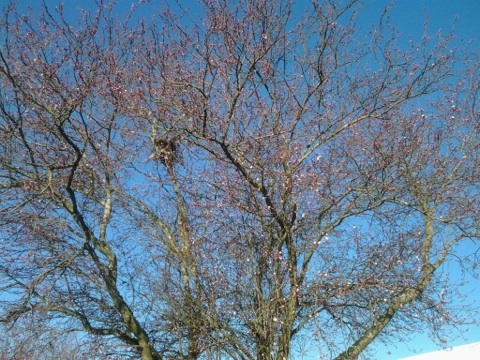
The cherry trees lining the street where I work now are in bloom.  I have the privilege of walking by them several days a week.  Many of the buds have opened.

The "For Rent" sign was removed from this nest on Monday afternoon.  Renovations are underway and the new tenants are noisy and cheeky....

The “For Rent” sign was removed from this nest on Monday afternoon. Renovations are underway and the new tenants are noisy and cheeky….


This afternoon, there are more blossoms open.  Tomorrow the show of pink against blue should be stunning.

Tuesday Blossoms and the sky is even bluer....

Tuesday Blossoms and the sky is even bluer….


I have been privileged to stand watch as a four hour sunset turned into a four hour sunrise.  That was many July’s ago during a 12 hour graveyard shift on the roof of a coker at Syncrude.

I do not have a photograph, only memories…  Inside the plant, personal cameras are not allowed to be carried by employees.


Today is February 23, 2014.

The photos of the cherry blossoms were taken in Richmond, British Columbia, Canada where in February’s past we have huddled under umbrellas, pulling our jackets close as the cold winds blew in off of the water.  I grew up here.  The cold winds and wet weather of winter are what is necessary to keep the rain forests green.


Climate change is real.


I have recently read Naomi Klein’s newest book, This Changes Everything:  Capitalism vs. The Climate.  I do not believe that she exaggerates any point.


Every small thing we do (or don’t do) to stop the change helps.

Mangrove Forests….

I just found a wonderful and interactive site!  Well, this isn’t just a site, this is a database and, it is worth a visit….

http://mangroves.elaw.org/map


~~~

Now, I tried to put the following into my own words but, it is so perfectly written that I have copied and pasted it here for you:

A Case for Mangroves
The approximately 70 distinct species of mangroves in the world cover roughly 17,000,000 hectares globally (Valiela et al.  2001) – only 0.12 percent of the Earth’s surface (Sullivan 2005, Ellison 2008).  The greatest diversity is in Southeast Asia (36-46 species); the lowest diversity is in the United States and the Middle East (1-3 species) (Polidoro et al.  2010).  Mangroves are being cut down or otherwise destroyed at such a high rate that they may be functionally extinct by 2100 (Duke et al.  2007).  In just the last 50 years, 30-50 percent of the global acreage has been lost.  (Alongi 2002, Duke et al. 2007)  Mangroves are among the most valuable and most threatened ecosystems on Earth.  The ecosystems services they provide—e.g., buffering coastal communities against flooding and storms, fiber production, habitat for thousands of species of birds, mammals and marine species—are estimated to be worth US $1.6 billion dollars/year (Polidoro et al.  2010).  In addition, recent evidence suggests that mangroves sequester carbon more effectively than any other tropical forest (Donato et al.  2011).”

This is important!


~~~

There are 65 of the most influential papers on mangroves and mangrove forests listed on this site.  All are worth reading but, we don’t all have that much time….

If there is a paper that you feel is missing, please add it in the comments below.  I look forward to hearing from you.


Dear Mr. Deity,

Thank you for sending us your newest YouTube video.  You have taken great care to explain why it is wrong to punch someone in the nose for not liking someone’s mom and I appreciate this!


A link to Mr. Deity

The Way of the Mister  —  These words are offensive!  This video is offensive!  It is a must watch!  I am not offended by this video, I am offended by the fact that the Catholic Church will probably get away with yet another offensive speech by yet another offensive leader, without understanding what it is they have done, are doing, and will likely continue to do.

I have a hard copy of the transcript (available beneath the YouTube video), just in case it disappears!

A link to the article in The Guardian where the Pope is quoted.


There is no excuse.


~~~~~

Now, a few bits from articles on a few of the points made by Mr. Deity (aka Brian Keith Dalton).  It is important because it is all connected!

Please note that I have not read any of these articles (yet).  I have taken a quick peek and I have saved and/or printed them for later perusal and bibliography mining!


~~~~~

Satire:

Botha, E.  2014.  A means to an end:  Using political satire to go viralPublic Relations Review, Volume 40, Number 1.  http://dx.doi.org/10.1016/j.pubrev.2013.11.023

Joan Ozark Holmer.  1981.  Religious Satire in Herrick’s “The Fairie Temple: or, Oberons Chappell.  Renaissance and Reformation: Renaissance et Réforme, Volume 17, No. 1, pages 40-56.

Drew Kaup.  2014.  Unaffiliation:  Where the New Atheists Went Wrong, and How South Park Paved the Way for the ‘Rise of the Nones’.  Thesis submitted to the Faculty of Emory College of Arts and Sciences of Emory University, Department of Religion.

Heather L. LaMarre, Kristen D. Landreville and Michael A. Beam.  2009.  The Irony of Satire:  Political Ideology and the Motivation to See What You Want to See in The Colbert ReportInternational Journal of Press/Politics, Volume 14, Number 2, April 2009, pages 212-231.

Richard Strier.  2011.  The Unrepentant Renaissance:  from Petrarch to Shakespeare to Milton.  University of Chicago Press.  (Available in libraries, bookstores and online.)

George W. Whiting.  1930.  Political Satire in London Stage Plays, 1680-83Modern Philology, Volume 28, No. 1 (August, 1930), pages 29-43.


Moral Credibility:

Dan M. Kahan.  1997.  Between Economics and Sociology:  The New Path of DeterrenceMichigan Law Review, Volume 95, No. 8 (August 1997), pages 2477-2497.

Paul H. Robinson.  1994.  Moral Credibility and CrimeThe Atlantic Monthly. 8/18/1994.  Draft only.

Paul H. Robinson and Sarah Robinson.  2014.  Punishment:  Drop City and the Utopian Communes, Chapter 3 in Living Beyond the Law:  Lessons from Pirates, Prisoners, Lepers, and Survivors.  Lanham, Boulder, New York, Toronto, and Plymouth, UK:  Rowman & Littlefield.  Pages 49-62.


The Catholic Pope and Violence:

Patrick McKinley Brennan.  2013.  Subsidiarity in the Tradition of Catholic Social Doctrine, Chapter in Subsidiarity in Comparative Perspective.  Michelle Evans and Augusto Zimmermann (eds.).  Springer.  Villanova University School of Law, School of Law Working Paper Series, 2012, Paper 173.

Jeffrey S. Burwell.  2014.  Pope Francis and Bill 18:  How his vision of non-judgment could temper the ways that administrators of Catholic schools in Manitoba integrate the Safe and Inclusive Schools amendment.  University of Manitoba, St. Paul’s College.

Christian Fiala and Joyce H. Arthur.  2014.  “Dishonourable disobedience” – Why refusal to treat in reproductive healthcare is not conscientious objection.  Women – Psychosomatic Gynaecology and Obstetrics, Volume 1, December 2014, pages 12-23.

Warwick Middleton, Pam Stavropoulos, Martin J. Dorahy, Christa Kruger, Roberto Lewis-Fernandez, Alfonso Martinez-Taboas, Vedat Sar and Bethany Brand.  2014.  The Australian Royal Commission into Institutional Responses to Child Sexual AbuseAustralian and New Zealand Journal of Psychiatry, Volume 48, Number 17, pages 17-21.  DOI: 10.1177/0004867413514639

Kurt Nelson.  2014.  Review of Faith, Resistance, and the Future:  Daniel Berrigan’s Challenge to Catholic Social Thought.  James L. Marsh and Anna J. Brown (Eds.).  New York:  Fordham University Press, 2012.  (Available in libraries, bookstores and online.) Journal of Catholic Education, Volume 17, Issue 2, Article 11, pages 175-178.

Gareth C. Payne, Rebecca E. Payne, and Daniel M. Farewell.  2008.  Rugby (the religion of Wales) and its influence on the Catholic Church.  Should Pope Benedict XVI be worried?  BMJ.com  doi:10.1136/bmj.a2768


Freedom of Speech:

Zechariah Chafee, J.  1919.  Freedom of Speech in War TimeHarvard Law Review, Volume 32, No. 8 (Jun., 1919), pages 932-973.

Erwin Chemerinsky.  2000.  Content Neutrality as a Central Problem of Freedom of Speech:  Problems in the Supreme Court’s ApplicationS. Cal. L. Rev. 74:  49.

Charles C. Helwig.  1995.  Adolescents’ and Young Adults’ Conceptions of Civil Liberties:  Freedom of Speech and ReligionChild Development, Volume 66, Number 1,  Pages 152-166.

Lasa Sun.  2014.  The role of diversity on freedom of speech in democratic societiesInternational Journal of Sustainable Human Development, Volume 2, Number 2, pages 44-51.

Gary Watt.  2014.  Judicial Allusion as Ornament:  A Response to John Curtis’s, ‘Twitter, King Lear, and the Freedom of Speech.’  Exchanges: the Warwick Research Journal, Volume 1, No. 2.  University of Warwick.


~~~

I have given myself a big list to prepare for you!  A combined bibliography with links will be available soon.  If I take too long, please send a  note.  It helps to know there are people waiting for these.


~~~

Now, go read!  Then make up your own mind and leave a comment…

Also, please add links to more articles and books in the comments.  There is so much more!


An Oilspill on December 15th, 2014 in the World’s Largest Mangrove Forest. Why isn’t this on the news?

The oilspill in the Sundarbans National Park seems to have been all but ignored by world news services.  I heard about it on a blog, SkyTruth, and decided that there must be information out there that would help me to understand the area, the damage, and the responsibility.

There is.  There is a lot out there to read!  Scientists and other concerned people have been writing about pollution, oil spills and clean-ups for a very long time.

Here is some of what I have been reading as well as some of what I will be reading:

~~~~~

The Sundarbans National Park – A UNESCO Heritage Site

The Sundarbans is an area composed of rivers, some arable land and the largest mangrove forest on earth.  It is also home to some of the poorest people on earth.  There is no industry here.  There are no resource friendly alternatives to illegal fishing and hunting.  There are no jobs.  This is an area where caste restricts choices.

Abhiroop Chowdhury and Subodh Kumar Maiti.  2014.  Mangrove Reforestation through Participation of Vulnerable Population:  Engineering a Sustainable Management Solution for Resource Conservation.  International Journal of Environmental Research and Development, Vol 4, No 1, pp. 1-8.  Link

There is a novel that depicts the Sundarbans as treacherous with humans holding on to a tenuous existence in the presence of an untamed nature.  (The Hungry Tide by Amitav Ghosh, 2005.)  Even the islands that dot the waterways are not constant but change, grow, disappear and reappear with seasons and storms.

Louise Squire.  2014. The Thoughts in our Head: A World.  Alluvium, Vol. 3, No. 1.  Link

Huma Yaqub.  2014.  Tides of Change Breaking against the World of Sundarbans:  A Study of Amitav Ghosh’s The Hungry Tide.  International Journal of English Language, Literature and Humanities, Vol. II, Issue V, pages 104-113.  Link

Mangrove Forests:

Ken W. Krauss, Karen L. McKee, Catherine E. Lovelock, Donald R. Cahoon, Neil Saintilan, Ruth Reef, and Luzehn Chen.  2013.  How mangrove forests adjust to rising sea level.  New Phytologist, doi:  10.1111/nph.12605  Link

Daniel M. Alongi.  2008.  Mangrove forests:  Resilience, protection from tsunamis, and responses to global climate change.  Estuarine Coastal and Shelf Science, Vol. 76. pages 1-13.  Link

Kandasamy Kathiresan and Narayanasamy Rajendran.  2005.  Coastal mangrove forests mitigated tsunami.  Estuarine Coastal and Shelf Science Vol. 65, pages 601-606.  Link

Daniel M. Alongi.  2002.  Present state and future of the world’s mangrove forests.  Environmental Conservation, Vol. 29, No. 3, pages 331-349.  Link

Ivan Valiela, Jennifer L. Bowen, and Joanna K. York.  2001.  Mangrove Forests:  One of the World’s Threatened Major Tropical Environments.  BioScience, Vol. 51, No. 10, pages 807-815.  Link

Tigers:

Chloe Inskip, Zubair Fahad, Rowan Tully, Thomas Roberts, and Douglas MacMillan.  2014. Understanding carnivore killing behaviour: Exploring the motivations for tiger killing in the Sundarbans, Bangladesh.  Biological Conservation, 180, pages 42-50.  Link

Chandan Kumar Mondal, Bholanath Mondal, and Debashis Sarkar.  2014.  Study on Utility and Revival through Community approach in Sundarbans Mangrove.  International Journal of Social Science, Vol. 3, No. 2, pages 191-203.  Link

R. Mani Murali, P.J. Vidya, Poonam Modi, and Seelam Jaya Kumar.  2014.  Site selection for offshore wind farms along the Indian coast.  Indian Journal of Marine Sciences.  Vol. 43(7).  Link

Dolphins:

B.E. Smith, G. Braulik, S. Strindberg, R. Mansur, M.A.A. Diyan, and B.Ahmed.  2012.  Habitat selection of freshwater-dependent cetaceans and the potential effects of declining freshwater flows and sea-level rise in waterways of the Sundarbans mangrove forest, Bangladesh.  Aquatic Conservation:  Marine and Freshwater Ecosystems, Vol 19, pages 209-225.  Link 

Ram Boojh.  2014.  Ensuring Sustainability of Wetlands in the Global Context, in International Conference on Lakes & Wetlands:  Bhopal, India.  Link

UNESCO World Heritage Sites:

This Link will take you to a map of all of the UNESCO World Heritage Sites.  Just point and click or, search for the Sundarbans.  Link

~~~~~

How did we find out about this spill?  Satellite images!  I would like to find something a little more current but, for now this is interesting….

Mervin F. Fingas and Carl E. Brown.  2000.  Review of Oil Spill Remote Sensing.  Emergencies Science Division, Environment Canada.  Environmental Technology Centre, Ottawa, Ontario, Canada.  Link

~~~~~

What have we learned and what do we do?  Whatever it is, we must do it carefully and with thought for the future….

Luis A. Soto, Alfonso V. Botello, Sergio Licea-Duran, Marcial L. Liarraga-Partida, and Alejandro Yanez-Arancibia.  2014.  The environmental legacy of the Ixtoc-I oil spill in Campeche Sound, southwestern Gulf of Mexico.  Frontiers in Marine Science, Vol. 1, Art. 57, pages 1-9.  Link

Naomi Klein.  2014.  Chapter 13: The Right to Regenerate.  In, This Changes Everything:  Capitalism vs. The Climate:  Canada:  Alfred A. Knopf.  Pages 419-448.  Link

Dagmar Schmidt Etkin.  2000.  Worldwide Analysis of Marine Oil Spill Cleanup Cost Factors.  Presented at:  Arctic and Marine Oilspill Program Technical SeminarLink

S.R. Pezeshki, M.W. Hester, Q. Lin, and J.A. Nyman.  1999.  The effects of oil spill and clean-up on dominant US Gulf coast marsh macrophytes:  a review.  Environmental Pollution 108, pp. 129-139.  Link

~~~~~

Where does the information in these papers come from?  Research!  Research by the authors of these papers and by researchers and authors before them.  A selected bibliography is here (this will be a large file!):  Soon….


~~~

Added on February 8, 2015.

A collected bibliography, most gathered from the above articles but not all, for you to peruse.  Possibly, this bibliography could be called ‘second generation’ as it provided the writers of the above research papers with documented research that they could use and further….

Reading List – Blog Post Dec 21, 2014

This document is fairly long.  There is a lot of good information in there, research and writing by many very qualified science specialists and others…..  I began to put links in to the articles in this list but, there are just too many.  If you have trouble finding anything on this list just leave a comment below I would be more than happy to take a look and see if I can help.


Is this all the choice we get? Gender Bias in Universities…

There is a photograph on the home page of the Kwantlen Polytechnic University Website that I initially found amusing but after thinking about it for a while, I have decided that I actually find it offensive.

It is a photograph of a row of shoes.  Three pairs are black, one pair is brown, one pair is white.  Three are kind of dressy, two are kind of casual.  Two are flats, three have heels.  Four have a strap across the instep, one doesn’t.   All five pairs of shoes would be appropriate for an entry level position in an office environment (my opinion only, I am sure you could wear them other places too….)  The shoes are not the problem.  The problem is the caption at the top of the photograph:


“Career Choices and Life Success
Attend an information session to learn more about this program.” 
 ccls-itsf-slider[1]

Kwantlen Polytechnic University Home Page link

Photograph and caption are being used here for educational purposes only.  Fair use.

~~~~~
There is one pair of feet filling the middle pair of low heel, white shoes.  Is this it?  Are the choices that these shoes represent the only ones that women can expect to fill?  Are the choices of women choosing this particular university literally this narrow?  And, why choose the middle pair (middle of the road)?  Why choose the white pair (I don’t want to go here right now – I will go here later!)?  Why choose the pair with the mid-range of heel height (again in the middle…)  Why choose the middle pair (the middle pair?  Did I ask this already)?  Would the corresponding line-up of men’s shoes have five pairs of middle-of-the-road, entry level office position style choices?  Who chose these shoes?
.
My problem:
.
Is this it?  Is this all the choice that a woman entering this university can expect?  Middle of the road, sensible, affordable shoes that are appropriate for an office setting?  I mean, careers?  Where are the CSA approved worked boots?  Where are the hiking boots for the archaeologists and geologists?  Where are the nursing clogs (these are not only practical but really comfy!)?  This row of five pairs of shoes doesn’t even have anything suitable for wearing into a fine arts class….
.
A peak into my closet (front to back, left to right):  Sensible tough walking shoes with sturdy soles.  Running shoes.  Strappy high heels.  Hiking boots.  Mid-heel black slip-ons.  More heels.  CSA approved green-tagged workboots (2 pair!).  More running shoes.  Another good sturdy pair of boots.  Rubber boots.  More strappy heels.  A pile of flip-flops (well, those might not be appropriate in too many work environments) and a couple pairs of sensible flats (these don’t get to work much either)….  You get the picture.  Life is about choice!  Dress for it!
.
.
~~~~~

Where are the university watchdogs?  The ones who sing at the top of their lungs if you accidentally put a “he” or a “she” into a piece of writing?  Where are the people from the student groups who managed to get two gender-free washrooms at the Surrey campus?  Well?  Where are they?  Or, is going after an approved photograph on the home page of the university website just a little too, ummmm….  up front and political?


~~~~~

Okay, link time.  I am not too certain where my article links might take me after this little rant but, I do know that they will probably be interesting.  If you know of any articles or papers that would fit in here, please post a link in the comments section.


~~~~~

Is there gender bias in university advertising?  This article is not specific to university advertising but it is interesting and does provide an active mind with lots of relevant questions….

Article:  Gender Issues in Advertising – An Oversight Synthesis of Research:  1970-2002.  link

Author:  Lori D. Wolin, Lynn University.  Publications Link

Published in:  Journal of Advertising Research [link].  March 2003

DOI:  10-1017/S0021849903030125

My copy was downloaded in December, 2014.  I found using Google Scholar.

Click to access A9001206.pdf


~~~~~

Does education that is traditionally gender-biased (nursing / trades) put a person at risk of being an outsider?  Having been through trades training and attained journeyman status (red seal tickets), I have to say that it does.  The following article, viewed from behind my background in the trades, is particularly interesting.

Article:  Fear Extinction to an Out-Group Face.  link

Authors:

Published in:  Psychological Science (link), Volume 20, Number 2, 2009 (Link).  Pages 155-158

My copy was downloaded in December, 2014 and I found it using Google.

Click to access Mendes_FearExtinction.pdf


~~~~~

Maybe feminine looking legs just have less risky preferences or is there a possibility that there is a lack of knowledge as to what the risks actually are?

Grey Paper:  Gender Differences in Preferences.  link

Authors:

Published by:  Harvard University

My copy was downloaded in December, 2014.  I found it here: http://www.hks.harvard.edu/content/download/70408/1254442/version/1/file/rachelcrosonandurigneez.pdf


~~~~~

The recruiters are out there, at the universities, looking for future banking, civil service, retail employees.  What about the other choices?  Is anyone actually doing any recruiting for the people that actually fit into the non-traditional roles?  They used to!

Article:  Girls.  link

Published in:  Fords and Raritan Township Beacon (Link)

Published on:  Friday, April 28, 1948

My copy was downloaded in December, 2014.  I found it using Google.

Click to access pg_0002.pdf


~~~~~

…and maybe, it just comes down to what we want and expect from our career choices.

Article:  A New Frontier for Title IX:  Science.  link

Author:  John Tierney.  Publications

Published in:  The New York Times

Published on:  July 15, 2008

My copy was downloaded in December, 2014.

Click to access tierney_TitleIX.pdf


~~~~~

After reading the above, I need to read this.  I have it on hold at my local university library!

Book:  The Sexual Paradox:  Men, Women and the Real Gender Gap (Link)

Author:  Susan Pinker.  Books

Published by:  Simon & Schuster, New York.

Published in:  2009


~~~~~

Not every question I ask gets answered.  In fact, most of my questions do not have answers or at least, they don’t have easy answers….  This stroll through academia is just that, a stroll.  For me, I ended up with more questions than I started with.  This is not a bad thing.  What are some of the questions you have?


~~~~~

If any of these links do not work, please contact me and I will try to help you find the article, paper or book that you are looking for.

If you find any broken links on this blog, please leave a comment or send me a note so that it can be repaired.  Thank  you….