Tag Archives: art

A Little Tag, A Lot of Silver Plate

This little tag came in among a lot of silverplate — tarnished black, easy to walk past, with what looked like a fancy letter on the front. A proper look under the loupe, and a little light polishing, told a very different story.
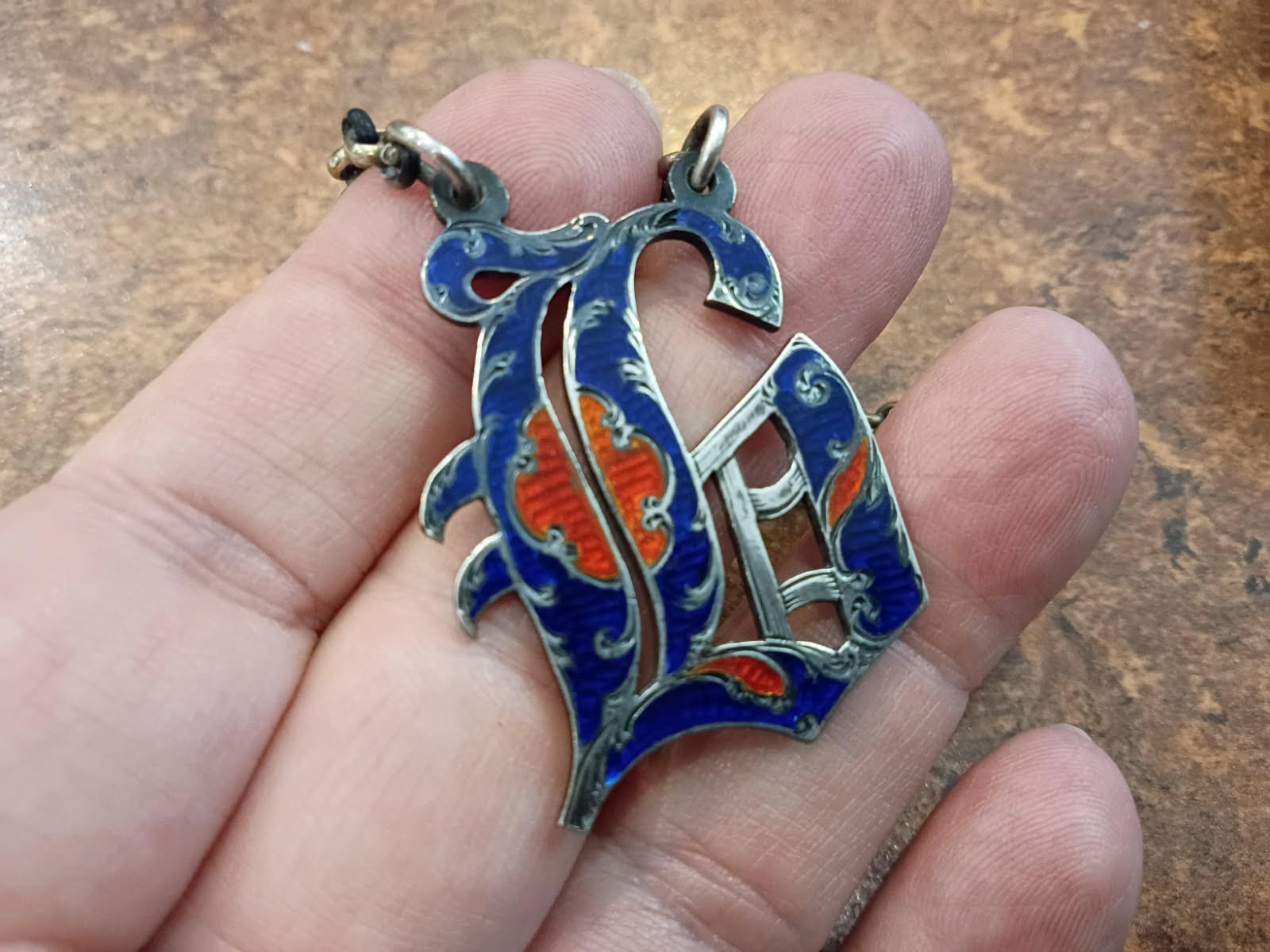
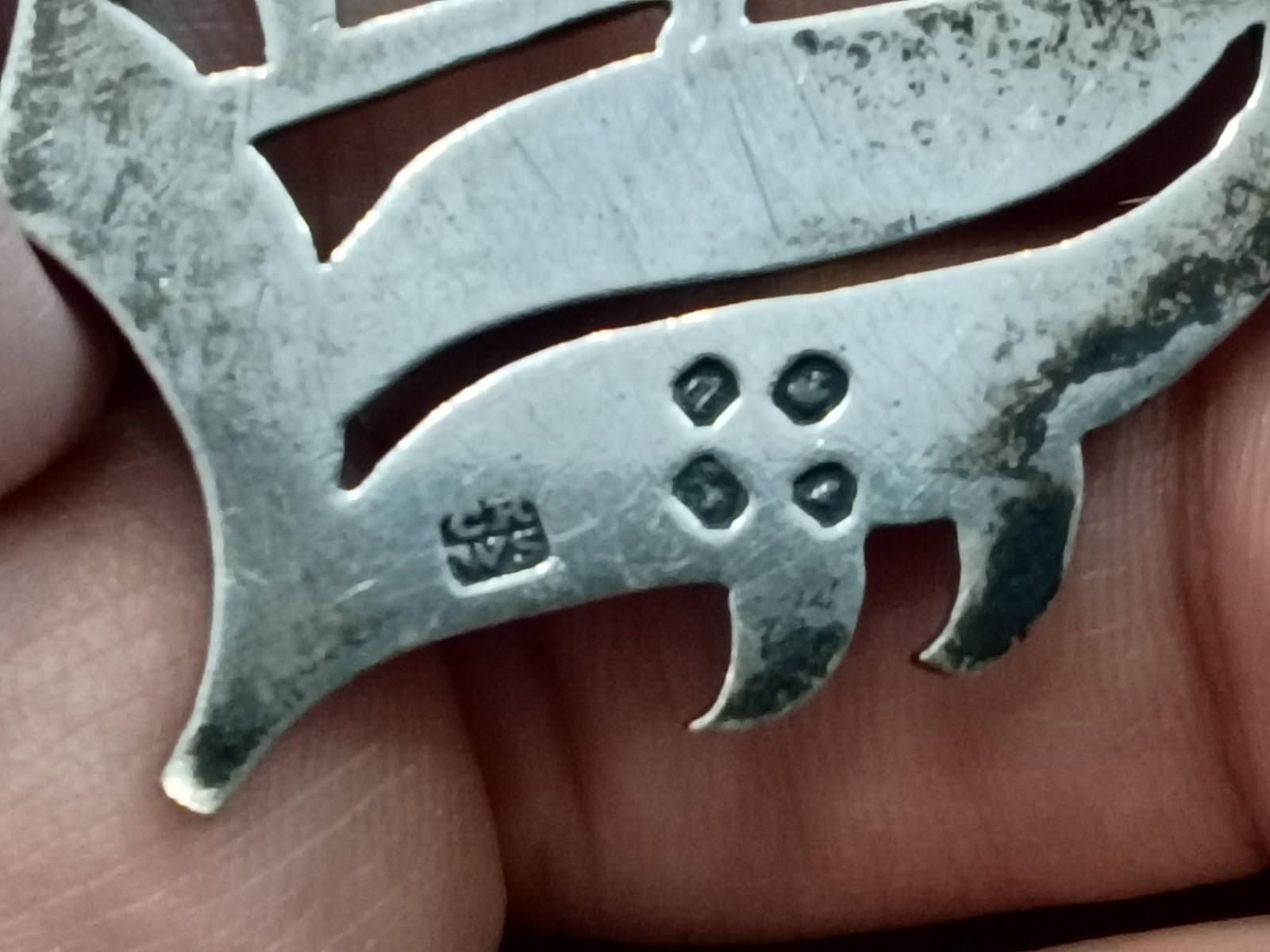
It’s a sterling silver wine label — the kind that once hung by a fine chain around the neck of a decanter, so a host could tell the Claret from the Port without pulling every stopper. This one is the letter “C,” for Claret — but in black-letter, the old Gothic script, which is why it looks so unlike the plain C we write today. The hallmarks date it to the year: London, 1848 — early Victorian, Queen Victoria on the throne eleven years — made by Charles Rawlings & William Summers, a London firm known for exactly this kind of small, fine silver.
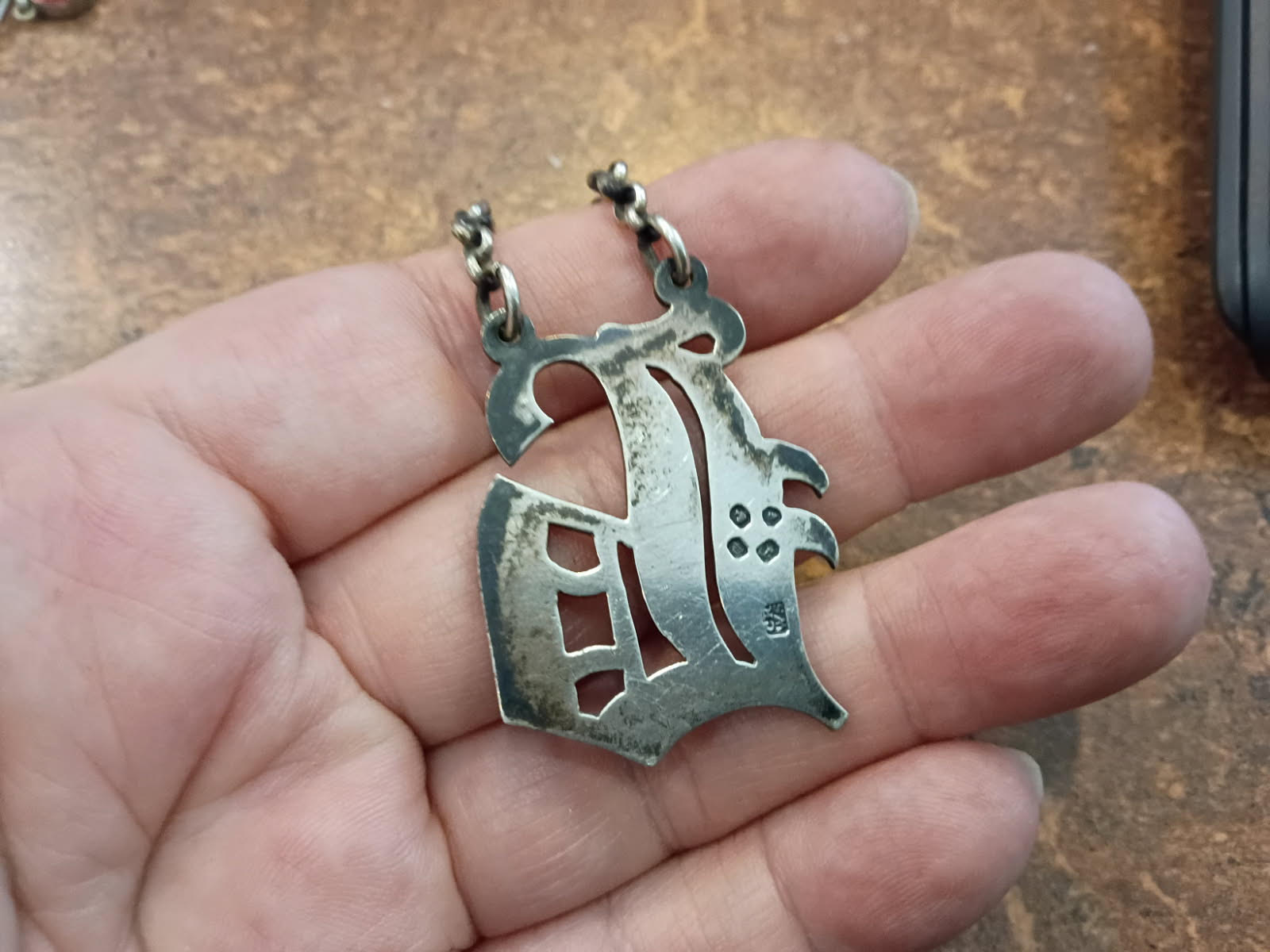
Now, the colour — because this is the part worth slowing down for.

It isn’t paint, and it isn’t a coloured stone. It’s enamel, which is powdered glass fused to metal in a kiln. But it’s a particular, harder kind called basse-taille (French for “low-cut”), and here’s the trick of it: before any glass goes on, the silversmith hand-engraves the silver underneath in a fine, wave-like pattern. Then translucent red and blue enamel is laid over that engraving and fired. Because the glass is see-through, light passes down through the colour, catches the engraved silver beneath, and bounces back up — so the piece doesn’t just sit there flat, it glows and shifts as it moves. Every wave you can see under the red is a cut made by hand, one at a time, on a piece less than half the size of a business card.
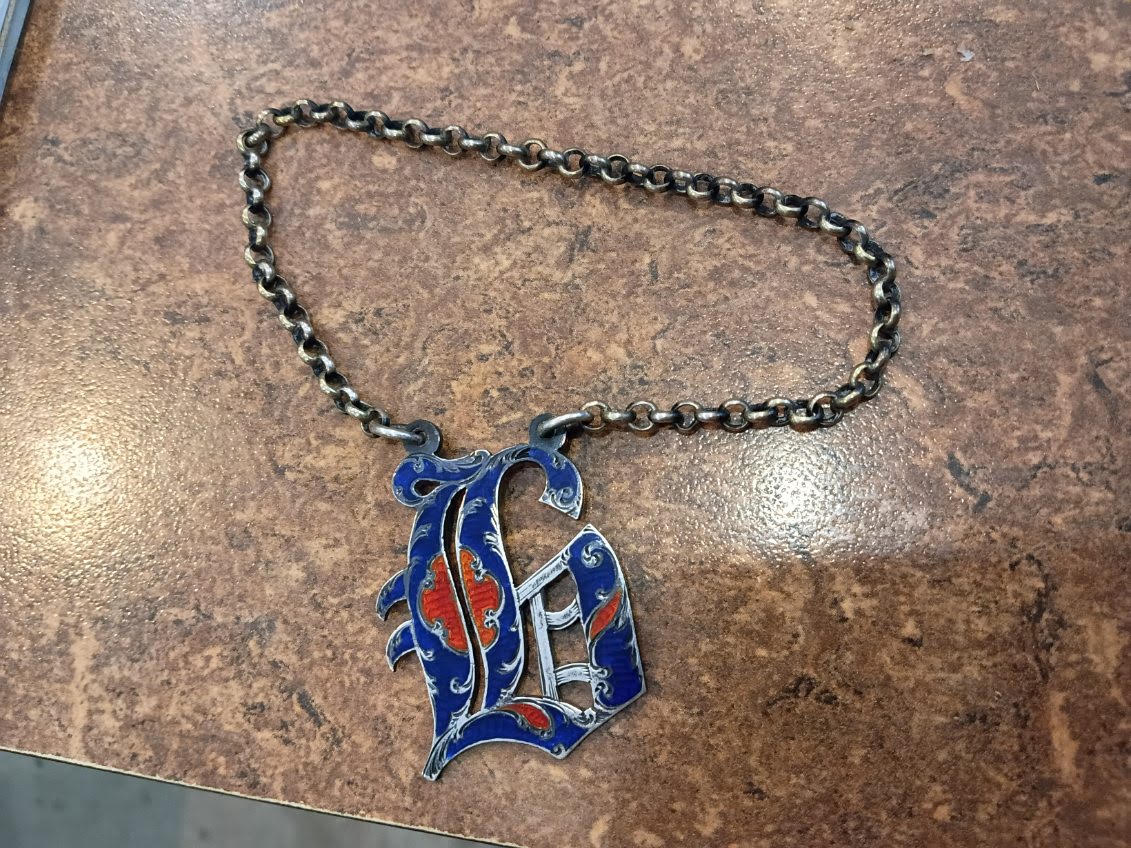
It’s slow, exacting work with no margin for a slip — the enamel either comes out of the kiln clean or it cracks and you start over. Which makes the condition of this one quietly remarkable: 178 years, and not a single chip.

A small thing, a lovely thing — and older than the province it now sits in. (British Columbia joined Confederation in 1871. This label already had a 23-year head start.)
And that’s rather the point. This nearly went out with the plate. So before the next houseful of “old junk” heads for the curb — before you hand the boxes to the fellow with the truck — give the small, dark, unglamorous things a slow look. The tag nobody can read. The dented little spoon. The thing that “can’t be worth anything.” That’s exactly where the good stuff hides, and once it’s gone in a bulk lot, it’s gone for good. If a piece has you puzzled, bring it in and we’ll look at it together. No charge to wonder.

Leslie
778-708-0454

The Pound & the Provenance
7791 Steveston Highway
(northwest corner of No. 3 Road and Steveston Highway)
Richmond, BC, Canada

~~~

Please Note: I am not an appraiser, a seamstress, a silversmith, or a gemologist. I am an antiques dealer. A generalist with a love for things with a bit of age. I had a stroke, four years ago, and AI is helping me to do better than I would have. Nothing here is false, everything here is true. I hope you enjoy it and please leave a message.

Ref. no. 1075

Exploring the Sacred Places in Our Communities: A Precis of an Article by Mark A. Graham

This is an article that is worth taking the time to find and read.  It is interesting and there are more than a few smiles related….

~~~

Article:  Exploring Special Places: Connecting Secondary Art Students to Their Island Community

Author:  Mark A. Graham

Source:  Art Education, Vol. 60, No. 3 (May, 2007), pp. 12-18.

Published by: National Art Education Association.

Stable URL: http://www.jstor.org/stable/27696211

My copy was downloaded on October 1, 2014.

~~~

My Precis

Expanding personal and sacred place to include community, through art, can break down barriers and lead to the type of experiences and understanding that brings about responsibility and social change.

~~~

My Precis Expanded (a summary of the original article):

Research suggests that art education must have a compelling personal and cultural context if it is to succeed in creating new ways of thinking, knowing and representing. Artmaking in the classroom provides an opportunity to give form to the transformation and reshaping of ideas, experiences and materials into meaningful representations. This article describes the efforts that one group of students made to understand their community and history through art.  Our lives are often led within a fractured world that has become a place to be taken for granted, owned, used up, and discarded. Place-based education aims to bring together nature and communities by breaking down isolation and emphasizing responsibility.

Life is about possibilities and art connects life through associations.  Transcendent art can be filled with sacred images or images that the artist held sacred, thereby attaching meaning and revealing aspects of nature and reverence without religion. By making ecology of place the focus of their work, many contemporary artists are attempting to connect community and the preservation of the natural environment.  The aim of exploring and learning about the ocean, animals and trees that we share in our communities is to cultivate a thoughtful awareness and a sense of reverence towards our homes.

In a museum, detailed images are constructed and places depicted in order to build a vocabulary to further help us in the exploration of another’s place. To define sacred place through experience and memory, students were asked to share details of personal spaces that they considered sacred. In the area surrounding the school there is an 18th century graveyard as well as abandoned excavation sites, parkland and shoreline. Armed with sketchbooks and cameras to record nature’s resistance to America’s consumer culture, the students appeared in the classroom each Monday with a collection of images and questions. These questions facilitated discussions about home and homelessness and about our place in this world and our responsibility to others.

The students began a collage with photographs they had taken.  The photographs  were soon joined together into paintings as images of rocks, ocean, trees and street formed various personal meanings within the larger images. Borders that both connected and displaced became a theme and, as confidence grew, one student added family to her paintings and eliminated some of the isolation of displacement. A photographic collage of Main Street not only contained the sophistication of adolescent conversation caught up in music, fashion and identity, it was a reminder to us that a street is a panorama of architecture, trees and water connecting a small area (community) to the greater community of city, state and country. Bridges joined communities and in a collage, a bridge can also work to manipulate time by joining together the past and present.

The conversations and images came together in the final exhibition. Each student prepared and displayed a written commentary about their work. Each piece was mounted and hung in a sequence that included preliminary plans, sketches, studies, and final paintings.  The exhibition introduced other members of the community to our newly discovered sense of place and it was a success because it connected the artists (the students) with their environment (their home) on a level that brought awareness not only to them but to the community.

In order to understand our history we must learn it. Personal history can be found in our communities and in special places that help or have helped to shape our identities. Sharing, or teaching, is often referred to as the best way to learn and in this instance, visual art precipitated the sharing of personal interaction with sacred place.

~~~

I found the original article through a journal search using JSTOR. This one was a bit tricky to find. My copy came from here: http://www.jstor.org.ezproxy.kwantlen.ca:2080/stable/10.2307/3981182?origin=api

JSTOR is in the process of ‘freeing up’ some of their journals so that we can borrow the older articles to read. I am hoping that this might soon be one of those journals….. If you have any trouble locating the article please contact me or, call your local college or university library for assistance.